

School discipline is one of the most persistent challenges school leaders and teachers face in the day-to-day running of classrooms. According to many reports, student behavioral problems worsened after pandemic-era school closures, and recent data suggests educators continue to struggle with managing student behavior.
Schools have not been well positioned to address the confluence of challenges underlying this trend. School districts, for example, are under-resourced to offer adequate mental health and counseling services—a problem that may grow more severe due to budget cuts.
On Aug. 18, 2026, the Trump administration released guidance on school discipline that addresses none of the challenging questions related to discipline that schools are navigating. Instead, the guidance letter mischaracterizes public schools’ obligations under civil rights law, promotes harmful stereotypes about students of color, and encourages ineffective discipline practices.
In this post, I outline what education leaders need to know about the Dear Colleague Letter (DCL) on racial discrimination in school discipline. In doing so, I describe what the nonbinding letter gets wrong about civil rights law and school discipline.
Background on the 2026 DCL
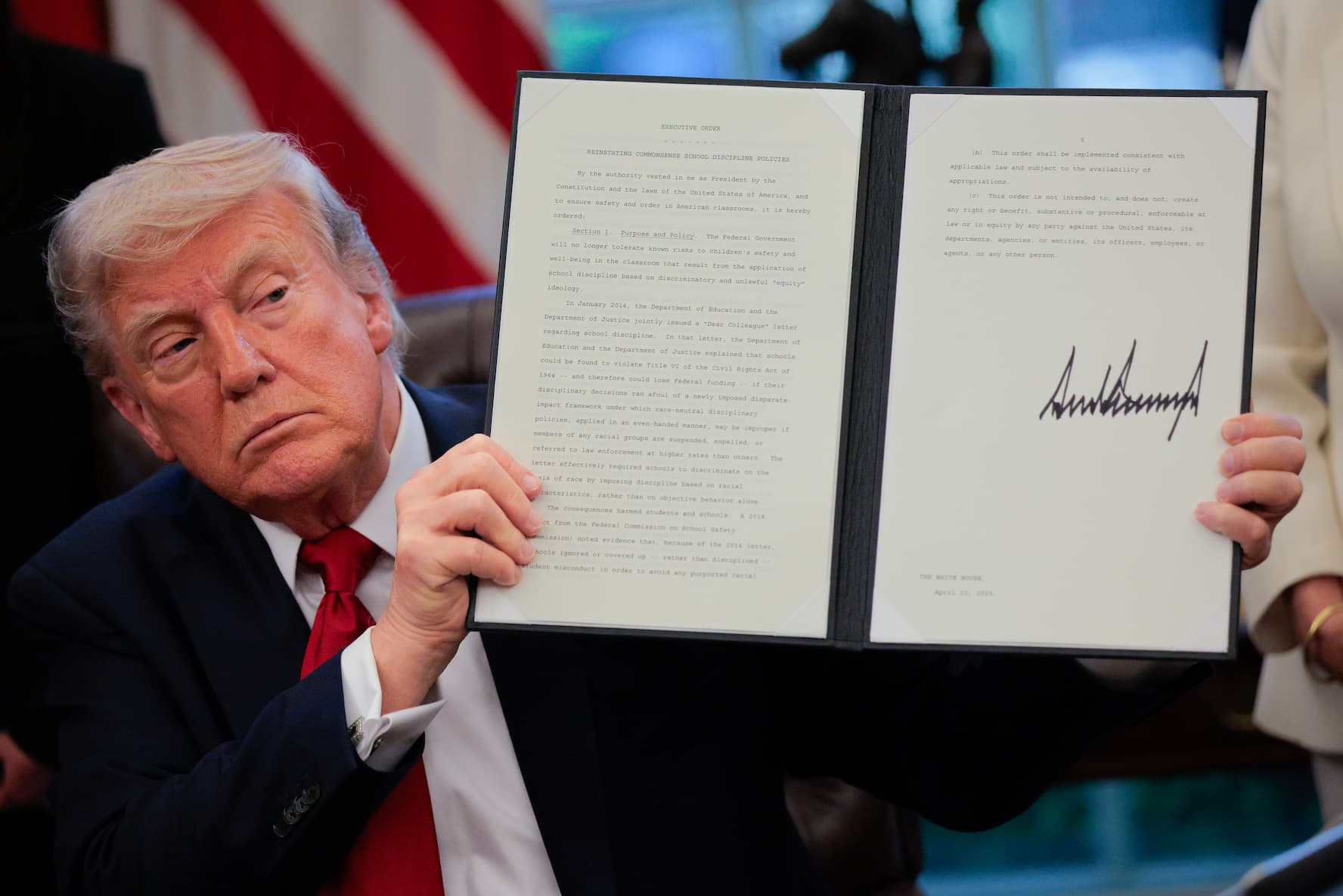
The letter comes in response to an April 2025 executive order calling for the U.S. Department of Education (ED) to issue updated guidance on how to avoid racial discrimination in the administration of school discipline. A Dear Colleague Letter is a nonbinding guidance document that is used to clarify schools’ obligations under existing federal laws and regulations.
The DCL sought to clarify schools’ legal obligations as they relate to racial discrimination and school discipline. It also aimed to explain the implications of the recently revised Title VI regulations (the rules that dictate how ED enforces Title VI of the 1964 Civil Rights Act, which prohibits racial/ethnic discrimination in federally funded schools and colleges). Notably, and controversially, those Title VI regulations removed the use of a disparate impact standard of discrimination. A disparate impact standard had allowed ED’s Office for Civil Rights to consider whether school policies or practices were discriminatory if they resulted in harsher punishments for one or more racial/ethnic groups but did not have clear evidence of discriminatory intent.
What, then, did the DCL say?
First, it made clear that it is illegal for schools to consider an individual student’s race or ethnicity when making discipline decisions. (This has always been illegal.)
Second, it made much broader claims about what constitutes illegal racial discrimination in discipline. According to the DCL, “a school’s decision to change its discipline policies with the purpose of avoiding or reducing racial disparities in discipline constitutes race discrimination.” Put another way, any race-conscious effort to remedy racial disparities in discipline through policy changes amounts to racial discrimination. This is a sweeping claim with significant implications for states and school districts. There’s one problem, though: That’s not what the law says.
What the 2026 DCL gets wrong about Title VI enforcement related to school discipline
The DCL’s first and most important error is that it mischaracterizes schools’ obligations under federal civil rights law. Let’s get back to those revised Title VI regulations. Those regulations differ from the prior regulations in only one way: the removal of the disparate impact standard. In effect, this means that ED, through its Title VI enforcement, can only identify illegal discrimination if it finds evidence of disparate treatment (a legal standard that requires evidence of discriminatory intent).
So, what if a school district is working to reduce racial discipline disparities by implementing a new, facially neutral approach to discipline? For example, what if school leaders are concerned about high suspension rates for their students of color and decide to adopt restorative practices (for all students)? Does that amount to racial discrimination under disparate treatment?
The answer, according to legal scholars, is no. In fact, it remains prudent for schools to monitor and address racial disparities in discipline. That’s because, despite the rescission of the disparate impact standard, evidence of racially disproportionate harm of a policy or practice “can be part of the evidence that establishes intentional discrimination.” Moreover, according to recent guidance on anti-discrimination protections released by attorneys general from 14 states, “taking proactive measures to remove unjustified barriers and ensure more equitable opportunities is legal, cost-effective, and benefits everyone.”
The DCL’s second error is that it perpetuates a series of falsehoods about the disparate impact standard, how it was used by past administrations, and the effects of disparate impact enforcement on school safety.
For instance, the DCL claims that disparate impact “effectively require[d] schools to discriminate on the basis of race by imposing discipline based on racial characteristics, rather than on objective behavior alone.” This is not true. According to the Education Rights Institute at the University of Virginia, racial disparities in discipline alone were never used as sufficient evidence of illegal discrimination under the disparate impact standard. What’s more, the Obama and Biden administrations never required racial parity in discipline as a necessary condition for compliance with civil rights law. Resolution agreements signed between ED and school districts during these administrations required process-related outcomes (e.g., redesigning student codes of conduct or offering teacher trainings), not student-related outcomes (e.g., equal suspension rates).
The DCL also makes several inaccurate or misleading claims about how discipline practices and school safety changed in response to an Obama-era DCL on school discipline, the first Trump administration’s move to rescind that DCL, and subsequent actions taken by the Biden administration. These claims include that the Obama-era guidance led to “increased levels of classroom disorder and school violence” as well as schools “ignore[ing] or cover[ing] up… student misconduct” to superficially avoid racial disparities in discipline. The DCL provides no serious evidence to support these claims.
What the DCL gets wrong about school discipline and racial disparities in discipline
The DCL also promotes outdated, ineffective ideas about what constitutes effective school discipline while perpetuating harmful, racist stereotypes about students of color.
First, the DCL repeatedly appeals to policies requiring “mandatory punishments.” However, research indicates that “zero-tolerance” approaches to school discipline are ineffective in reducing student misbehavior and improving school climate. The DCL also appeals to giving schools more discretion in the disciplinary process. However, an abundance of evidence indicates that educator and/or school-level discretion in the disciplinary process often yields unfair outcomes.
Second, the DCL presents a false dichotomy between racial equity in discipline and school safety. Reducing racial disparities does not have to come at the expense of promoting safe schools. In fact, when implemented well, efforts to promote racial fairness in discipline benefit the broader school environment. Redesigning school discipline policies and practices is difficult work. That does not mean it is not worth pursuing.
Third, the letter promotes the idea that racial disparities are natural and downplays the presence of discriminatory treatment at school. This runs contrary to what social scientists have documented across a wide range of study contexts using many compelling methodological approaches. Take, for example, a groundbreaking study by Jayanti Owens. Her research team produced a series of videos with teenage actors of different racial backgrounds acting out the same common misbehaviors. Teachers who watched the video with a misbehaving Black teen perceived the behavior more negatively and were more likely to say they would send the child to the principal’s office. This finding is consistent with results from several survey experiments, as well as analyses of administrative data where researchers have shown that Black students receive harsher punishments than their white peers despite being involved in observably identical infractions.
What’s most concerning about the falsehoods perpetuated in the DCL is that they imply that racial inequalities in discipline are inevitable and intractable. They suggest a false choice between school safety and racial fairness. The assertion that the problem is simply that kids of color misbehave more implies that efforts to reduce racial disparities in any meaningful way are pointless. These are pernicious ideas that will only serve to further entrench stubborn inequalities to the detriment of racially marginalized students.
Making sense of where we are
While a DCL does not carry the weight of law and, in this DCL’s own words, “do[es] not bind the public or create new legal standards,” it is clearly signaling a new approach to pressure districts to abandon their efforts to promote racial equality. On the same day the DCL was released, ED’s Office for Civil Rights announced that two districts—Fayetteville Public Schools in Arkansas and Milwaukee Public Schools in Wisconsin—were being investigated for concerns of racial discrimination in discipline. These investigations were not opened in response to concerns raised in either community (which is typically why investigations are initiated). Instead, ED moved proactively to investigate district-led efforts to address racial disparities.
Notably, Fayetteville’s efforts to implement restorative justice to reduce racial disproportionality were specifically called out in ED’s press release. Though, again, according to legal scholars and recent multistate guidance released by state attorneys general, proactively working to remedy racial unfairness in schools is not only permissible under anti-discrimination law but also prudent and cost effective.
Here, it is important to appreciate the context for this DCL. It comes amid broader efforts—in education and other sectors of public life—to weaponize civil rights enforcement, often against marginalized groups of people. Notably, many of the administration’s other efforts in this area have been thwarted. For example, a sweeping DCL released in February 2025 attempted to recast any race-conscious policies, programs, or efforts as racial discrimination. That letter and the administration’s subsequent enforcement efforts were thrown out by a federal judge who found the administration was attempting to use nonbinding guidance to “substantially alter the legal obligations of schools and educators without employing the procedures necessary to implement such a change.”
Clearly, though, the efforts to weaponize civil rights enforcement continue. As that work unfolds, it is critical for state, local, and school leaders to understand what their actual obligations are under the law and the considerable room they have to pursue more equitable student outcomes.
The Brookings Institution is committed to quality, independence, and impact.
We are supported by a diverse array of funders. In line with our values and policies, each Brookings publication represents the sole views of its author(s).