

This autumn, Europeans must decide on new terms of engagement with China. They are facing a surging EU trade deficit of €1bn a day, industrial deterioration across the continent and Chinese threats of economic coercion.
Trade commissioner Maros Sefcovic travels to Beijing this week for the final stretch of trade talks, just as Paris and Berlin publish a joint paper demanding tougher trade action against China. At a European Council summit later this month, leaders will be asked whether they wish to negotiate an agreement with China covering these issues—or whether instead to follow the Franco-German push and move to enforce European interests unilaterally by introducing tougher restrictions on China’s access to the single market.
In weighing this question, Europe’s leaders must settle three decisions: first, what rules to set for Chinese goods to enter the EU; second, what they want Chinese investment to contribute to European industry; and, third, where they should limit the roles of Chinese suppliers in critical infrastructure. Looming over all three choices is the geoeconomic reality that Beijing can retaliate—most critically, by restricting exports of critical minerals products to Europe.
The US experience
Recent US dealings with China offers guidance for how (and how not) to make such choices under threat of retaliation. In 2025, Washington assumed that imposing major tariff hikes would harm the Chinese economy and leave Beijing scrambling to make economic and political concessions. Instead, China responded by expanding restrictions on essential rare earth supplies. This put Western factories and defence production under immediate pressure. It forced the White House to de-escalate its tariff hikes and seek accommodation for a more predictable trade relationship.
Now, Washington is pressing ahead with targeted efforts to limit options for where Chinese companies sell, invest and operate. This includes restricting companies’ access to the US market beyond tariffs, while also curbing investment from China and increasingly banning the use of Chinese technology domestically. Despite China’s potent escalation options, the US is pursuing both stability and decoupling at the same time.
The lesson for Europeans is that talks and bargaining with Beijing can help contain escalation while enforcing their own rules across trade, investment and critical infrastructure.
How the EU navigates its season of decisions will determine whether it can successfully defend its industrial and security interests in the face of China’s threats of retaliation.
Three decisions for the EU
What China sells
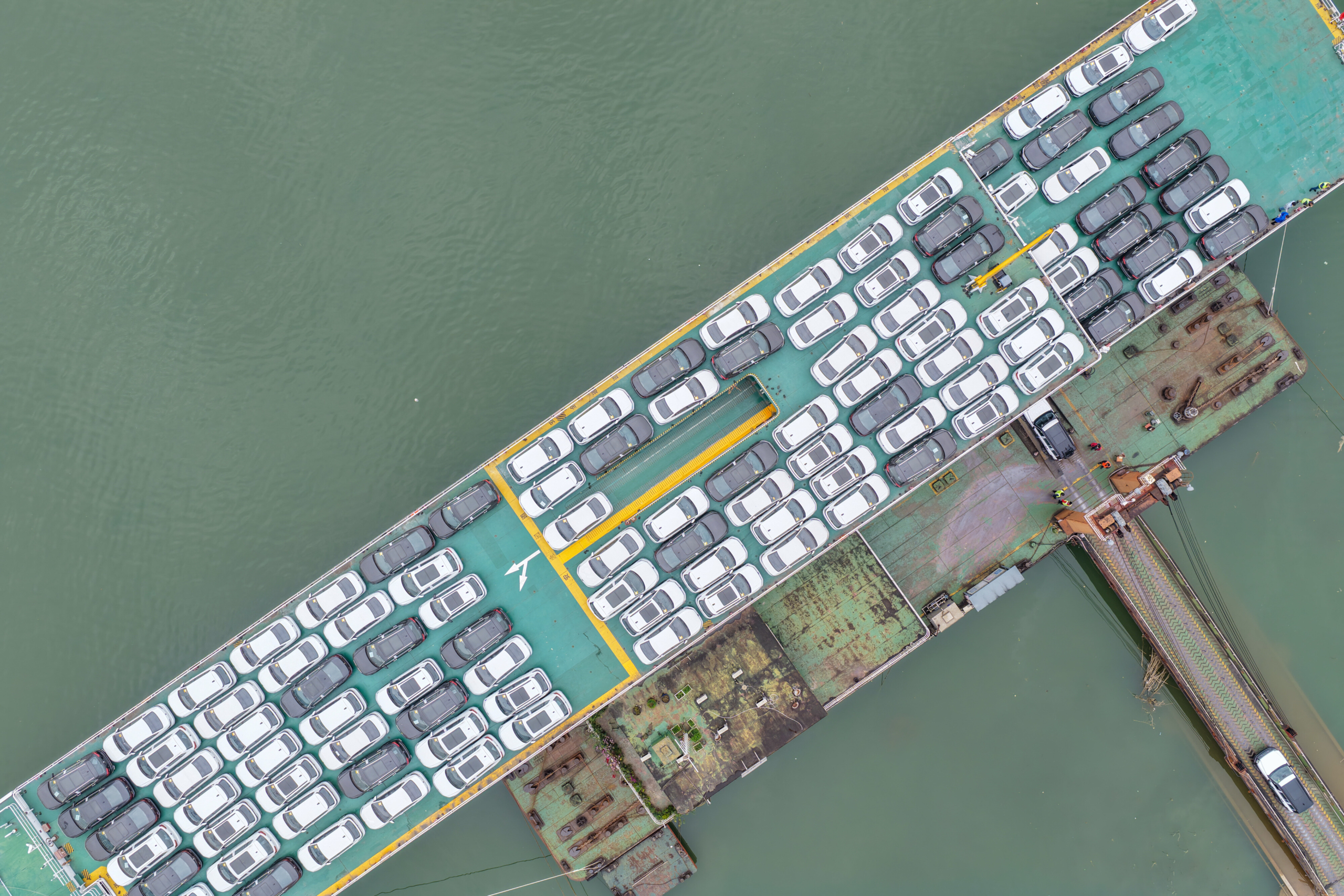
Europe’s first decision is whether to accept a narrow trade settlement with China in October. Such a settlement—for example, focused on automotive exports, which the two sides are currently discussing—may ease some tensions. It could see China voluntarily limit the number of electric and hybrid vehicles it sends to the EU each year. Or it could involve expanding so-called “price undertakings” in which individual Chinese producers agree to market entry terms, such as minimum import prices, total volume limits or local investment commitments. Volkswagen Anhui, one of the German company’s China-based joint ventures, already agreed to such terms earlier this year.
However, this approach risks failing to address wider industrial challenges posed by the Chinese system. Sectors other than the car industry are already under pressure from China’s industrial policies, including batteries, wind equipment, robotics, machine tools, chemicals and biotechnologies. But a narrow agreement would leave these areas untouched.
Any deal the EU strikes must therefore address these particular issues and support a level of stability between the EU and China—while also preserving the bloc’s ability to tackle other distortions from China independently.
What the EU should do
Making a deal on one product cannot become a promise to tolerate distortions impacting on others
Therefore, making a deal on one product cannot become a promise to tolerate distortions impacting on others. In the electric vehicle value chain, Brussels must retain its ability to launch anti-subsidy (and safeguard) investigations in other segments of the chain, like batteries, or sectors outside the scope of a settlement. The European Commission must also make use of the anti-circumvention tools it already has to close gaps created by Chinese producers redirecting exports through different locations or product categories. Unlike the Trump administration’s broad tariffs, trade defence measures calibrated to identified distortions would preserve competition in the single market while removing China’s artificial advantages.
The same logic must apply inside the single market, and Europe must maintain its autonomy to enforce a level playing field. This means the EU should be free to systematically launch and conclude investigations under the Foreign Subsidy Regulation across sectors where Chinese state financing is plausibly distorting competition in the single market. The bloc can also make assertive use of the international procurement instrument across every sector where documented procurement discrimination against European firms exists in China.
Furthermore, the EU must press ahead with upgrading its economic security toolbox, and make sure its contents are not beholden to any deal agreed with China. This includes developing a diversification instrument that could push firms in critical sectors to have a diversified supplier base (this could, for example, work by the EU placing tariffs on overdependent imports). It also means strengthening the anti-coercion instrument to lower the bar for activation, and adding a solidarity fund to compensate companies hit by retaliation and coercion.
Where China produces
Europe’s second decision is about what it expects in return when Chinese companies invest in the single market. Chinese investments in Europe (including Britain) have recovered from a previous lull, reaching almost €17bn in 2025 (nearly a quarter of all Chinese FDI), with 45% of that investment in the automotive and EV sector.
The problem for Europe is that, despite this rising investment, China’s exports are increasing at an even faster pace—supported by continued industrial policy support, persistently weak domestic demand and a weak yuan. Where Chinese investors are active in Europe, the risk persists that they will merely relocate final assembly while their supplier networks and technology remain tightly guarded. Without adequate safeguards, Chinese firms may set up “screwdriver factories” in the EU, which assemble largely pre-manufactured components, while retaining high-value activities in China. Indeed, Beijing has not only instructed its carmakers to follow this path, but also explicitly expanded its control levers to decide which automotive components are allowed for export.
What the EU should do
Europe’s trade and investment policies therefore have to work together. To ensure Chinese investors actually shift production to the continent, Europeans need to change the business arithmetic that makes exporting from China more profitable, whether by imposing tariffs or agreeing a managed trade deal. Where import barriers encourage Chinese investment, the EU must then ensure projects will develop local suppliers and support technology learning or transfer.
The EU’s proposed Industrial Accelerator Act, which is under negotiation, attempts to partially address this issue. Importantly, it marks a shift away from treating foreign investment in batteries, electric vehicles, solar power and critical raw materials as an automatic benefit. Under the plans, investments above €100m would have to meet four out of six conditions intended to generate industrial value in Europe (including introducing ownership limits, a joint venture condition, intellectual property sharing, local sourcing and more). Yet, as currently drafted, the only mandatory condition for foreign investors is to commit to local employment. The proposed design would create an à la carte system in which investors could avoid the requirements that are most important for supporting Europe’s industrial transition and scale-up.
It now falls to member states and the European Parliament to make more investment conditions mandatory if China wishes to enter Europe’s strategic industrial base. They should also future-proof the Industrial Accelerator Act by explicitly allowing the legislation to cover other sectors at the core of industrial competition, such as industrial robotics, wind equipment and medical technology.
What China controls
Europe’s third decision concerns where it allows Chinese suppliers a role in critical infrastructure and systems—and where they are excluded. Member states have in recent years strengthened their foreign investment screening powers and adopted a common approach to high-risk 5G suppliers. Yet the security risks today extend beyond these tools and sectors. They reach deep into European ports, energy systems and connected infrastructure.
Chinese state-owned company COSCO holds stakes in multiple EU port terminals, while ZPMC dominates global production of ship-to-shore cranes, including in European ports. Chinese companies still supplied nearly a third of 5G sites in 32 European countries in 2024, despite being designated as “high risk”. HMN Technologies has become the world’s third-largest supplier of submarine cables and is increasingly involved in European cable projects. Chinese cloud and self-driving firms are expanding in Europe, while Chinese-made solar inverters are connected to over 200GW of European solar capacity and supply 80% of all newly installed inverters.
Europe needs a consistent and unified way to decide where foreign equipment is intolerable. Beijing has already threatened consequences if the EU brings in security restrictions that affect its companies. It may want Brussels to freeze any such measures in place. But it would be a mistake for Europeans to trade their national security autonomy for a limited trade truce. China itself already applies a much more expansive version of this logic by treating Chinese technologies as inherently safer. It is already pushing European technologies out of its technology stack.
What the EU should do
The ongoing revision of the EU Cybersecurity Act, currently being negotiated between the commission, member states and the European Parliament, is of critical importance to building a common framework for assessing risky suppliers. The law could extend the approach developed for the 5G sector to other connected systems embedded in Europe’s critical infrastructure. This would mean both the commission and member states jointly assessing cyber risk not only at the technical level, but also according to whether a supplier could be subject to foreign manipulation or control. The act should apply, alongside additional sector rules, to connected equipment in ports, energy grids, connected vehicles, industrial control systems and other critical systems.
Where a supplier fails the test, the EU will need a clear timetable and financing to replace the most sensitive equipment. A binding and obligatory cybersecurity rulebook for Europe’s most critical sectors would give the EU better ways to defend the single market in the key battlegrounds of geoeconomic competition. Crucially, it must also allow trusted suppliers to compete, including those from partner countries.
Making Europe’s choices stick
The problem looming over all three decisions is Beijing’s ability to impose costs and impair Europe’s resolve to act—as both America and Europe found out in 2025. But compromise, autonomous action and escalation are not mutually exclusive options for the EU. Narrow sectoral accommodation of China, as long as it does not impinge upon Europe’s broader economic security agenda, can be a viable strategy, as Washington’s approach shows. The aim is not to wait for Beijing to change course, but to change the market logic that makes its current behaviour profitable. To do this, the EU must take decisions together as a system on trade, investment and critical infrastructure.
This also means, however, that Europe must accept the possibility of escalation. If the EU attempts to tackle these problems in a coordinated way, China will likely respond with coercive pressure. Preparing for that scenario means preparing for escalation, as the Paris-Berlin joint paper recognises. Their proposal for new deterrence powers, which would allow the banning of Chinese companies from the single market, is an important move. But Europeans can only successfully deal with their China problem when trade, industrial policy and economic deterrence are combined into a comprehensive agenda. Their message to Beijing must therefore be that they remain willing to settle specific disputes—but that threats of retaliation will not determine the rules under which Chinese firms sell, invest and operate in Europe.