

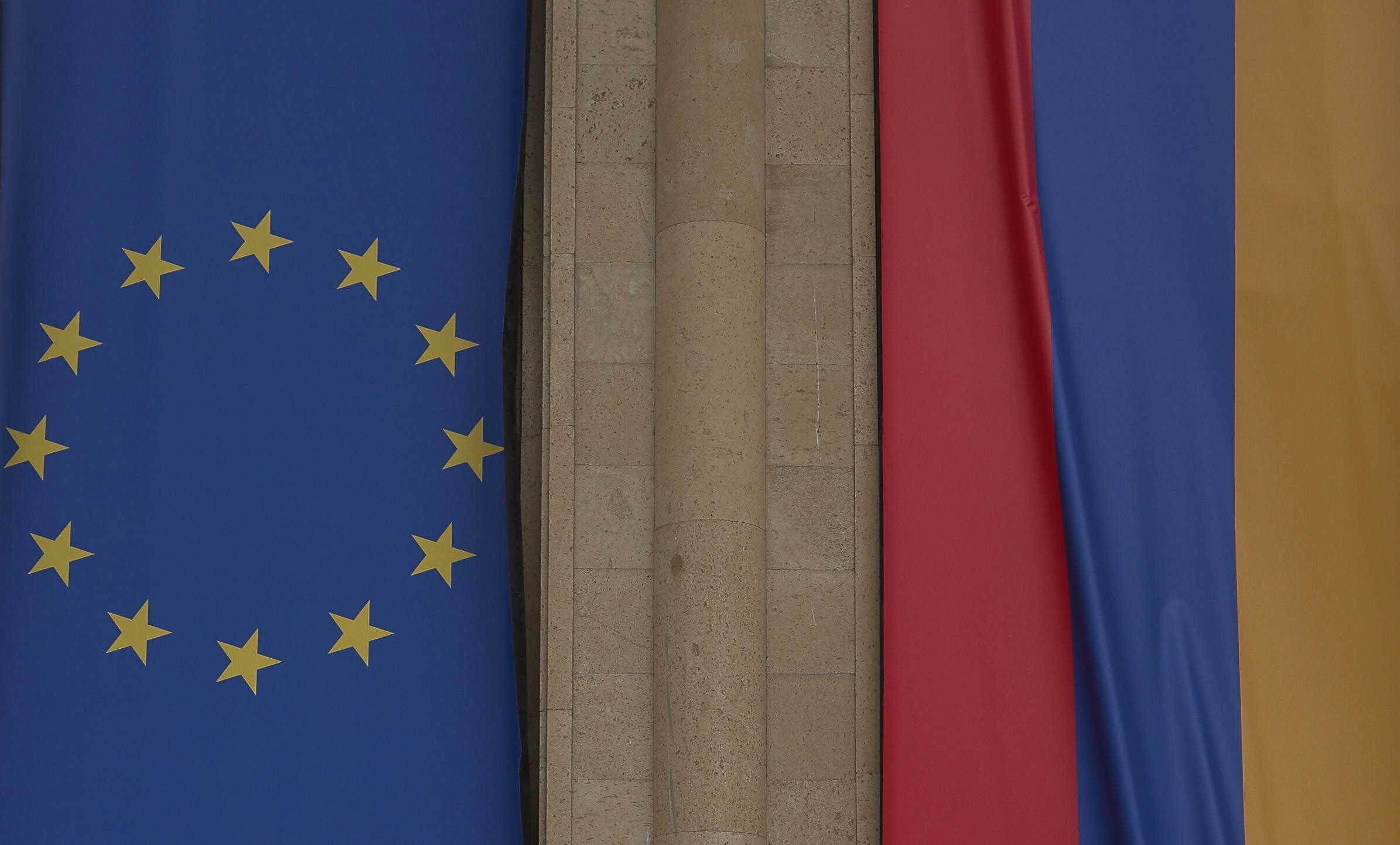
Armenia’s recently re-elected prime minister has a big task ahead: pivot his country away from Russia and towards Europe. Last month, he began preparing Armenia for its EU membership bid. The government is also pursuing a new peace initiative with old adversaries, Azerbaijan and Turkey. But it will take Nikol Pashinyan a lot more to secure a westward turn.
Yerevan’s European aspirations have not been well received by Moscow, which has restricted Armenian exports, paused its gas flows and threatened to tighten conditions for Armenians working in Russia. Leaving little to the imagination, President Vladimir Putin has gone so far as to say that Armenia could face a “Ukrainian scenario” if it continues down this path.
The frail peace process with Azerbaijan is making Armenia particularly vulnerable. Baku has made the signing of the peace treaty conditional on Armenia changing its constitution to recognise current borders. Yet Pashinyan does not have the parliamentary majority for such a change. As long as the peace treaty is unratified, Russia can exploit Armenia’s fragility.
Armenia’s turn away from Russia
Relations between Yerevan and Moscow began souring in Armenia’s 2020 Nagorno-Karabakh war with Azerbaijan. Despite Russia brokering the ceasefire and deploying about 2,000 peacekeepers, its security guarantees for Armenia ultimately failed, a weakness that the successive 2022 and 2023 crises with Azerbaijan have only made clearer.
This loss of trust in Moscow extends beyond the government to Armenian society more broadly. Yerevan has since frozen its participation in the Russian-led Collective Security Treaty Organization (CSTO) and reduced Russian military presence from parts of its border with Azerbaijan, Iran and Turkey. The new 2026–2031 government programme no longer describes Moscow as a strategic ally, marking a significant break with the language that had defined the relationship for decades. To fill the Russia-shaped hole, Armenia has diversified its partnerships and opened security cooperation with the EU, France, India and the US, reflecting a changing public opinion.
Between conflict and corridors
Part of this push to diversify rests on lasting peace with Azerbaijan. In 2025, US president Donald Trump hosted Pashinyan and Ilham Aliyev, Azerbaijan’s president, to sign a joint declaration formally ending the conflict and to initial the drafting of a peace agreement. Smelling a good deal, Trump also announced a connectivity project—the Trump Route for International Peace and Prosperity (TRIPP)—which would connect mainland Azerbaijan with Nakhchivan through Armenian territory. This would create a trade route from Asia to Europe through Turkey, forming an east-west corridor that circumvents Russia and Iran. For its part, America stands to financially gain, both in its majority stake of the TRIPP and by creating opportunities for major US firms.
Pashinyan’s vision of Armenia as a transit economy relies on the idea that connectivity and economic interdependence reduce incentives for conflict, while renewed fighting carries ever greater costs. All of this would require the borders with Turkey opening, which for now, Ankara, Baku’s close ally, will not do until Armenia changes its constitution.
Meanwhile, Iran is not keen to have a Western-backed transit route on its northern frontier, and has conditioned its acceptance on Armenian control of the route and no US security or military presence. If Tehran follows this through, Baku may well harden its own demands, pushing the peace process further into the distance.
Moscow has no interest in seeing these dilemmas resolved. The TRIPP and the wider US-led peace effort would significantly loosen Armenia’s dependence on Moscow, which is built on closed borders and an absence of relations with Baku and Ankara. It also removes an unresolved conflict that gave Moscow leverage for decades and survived years of failed Russian mediation.
Moscow can simply act in the hope of producing domestic disappointment in Pashinyan’s Western turn
To revert Pashinyan’s diversification efforts, Moscow does not need to force Yerevan to change course; and currently occupied in Ukraine, Russia does not have the military capacity to do so. Instead, Moscow can simply act in the hope of producing domestic disappointment in Pashinyan’s Western turn by devaluing the peace treaty before any constitutional change can be put it in place. In other words, Russia can try to ensure that the benefits of peace with Azerbaijan—geopolitical stability and economic gains—never come.
The pressure points are well established. Russia typically supplies about 80% of Armenia’s natural gas and it owns the transmission and distribution network. Armenia also hosts the only operating nuclear power plant in the south Caucasus, Metsamor, which is dependent on Russian fuel and maintenance. And, instead of pressuring the state directly, Moscow can use its domestic actors to challenge Armenia’s diversification. It already maintains a pro-Russian opposition through foreign political funding and misinformation networks—just as it did in Georgia.
Changing the price of unpeace
To support Armenia in its shift, Europeans need to help change the price of unpeace—especially while Russia is still occupied with its invasion of Ukraine. To do so, European governments can reduce Moscow’s capacity to punish Armenia for diversifying and make the benefits of peace visible beyond Pashinyan’s constituency. This will be particularly crucial ahead of a vote to change the constitution. Looking further ahead, Europeans should also help create resilient institutions that a successor government would find difficult to dismantle.
[Moldova shows that this approach can work. Ahead of its 2024 referendum and presidential election, the country faced extensive Russian interference, including illicit financing, vote-buying networks, cyberattacks and disinformation. But some of Europe’s defences were already in place: an EU sanctions regime targeted actors seeking to destabilise Moldova’s democratic process, while the EU partnership mission had been strengthening the country’s resilience to hybrid threats. Ten days before the vote, the European Commission also unveiled a €1.8bn Growth Plan. In the end, Moldova held its pro-European course.]
[Georgia offers a warning from the opposite direction. There, Moscow helped the ruling Georgian Dream party reverse the country’s pro-European trajectory by exploiting fears of renewed war and amplifying anti-Western narratives—despite overwhelming public support for EU integration. Its accession process had already been de facto paused before the October 2024 election and democratic backsliding has since deepened. ]
When it comes to Armenia, the EU should have a short-term and long-term strategy. Short-term measures, mainly trade, can be activated immediately (and some already are). Because they do not need the peace treaty’s ratification, this can make the gains of the pro-European course visible early on. Europeans should hence put money and market access where Moscow has applied pressure. The EU has already adopted temporary trade measures for two years that would make about 80% of Armenian exports to the EU tariff-free. It should be ready to speak of extension if Russian coercion persists. Additionally, visa liberalisation should move quickly whenever Armenia meets the relevant conditions. The EU should also seek voluntary agreements with mobile operators to reduce charges for calls and data when Armenians travel in the EU, a move that has proven popular in Moldova.
Long-term measures should be focused on strategic engagement that creates institutions and habits of cooperation. The EU’s Armenia monitoring mission mandate expires in February 2027; the bloc should commit early to extending it. The partnership mission launched in July, aimed at hybrid threats, complements this. Together they build institutional capacity that survives a change of government.
The EU should also fund civil society directly. The focus should be on border communities and displaced people to encourage groups outside of Yerevan to participate through small grants and simpler application rules. The case of Georgia shows why grants alone can be insufficient when authorities close the civic space. Such support stands a better chance when it is introduced early and combined with the measures above.
In some ways, Armenia’s EU aspirations seem distant. The country is still part of the Eurasian Economic Union alongside Russia and it hosts Russian troops. But under Pashinyan, it has begun its turn. Europeans can help Armenians make this change last by making Russian coercion less effective and the benefits of peace more widely shared. Europe will then reap some benefits of its own from the trade corridor, too. Moldova shows this is achievable when support arrives ahead of the test. Georgia shows the cost of assuming that a society’s European aspirations will secure their political future on their own.