

US secretary of state Marco Rubio described NATO’s July gathering in Ankara, two months before it convened, as “one of the more important leaders’ summits in [its] history.” The summit confirmed that Europeans have accepted America’s expectation that they do more for their own security. The Ankara declaration recognised that “European allies and Canada, working together with the United States, are assuming greater responsibility for the alliance’s defence.” Accepting that shift is one thing; paying for it is another. For European policymakers the question is now fiscal. It turns on what Europe is willing to pay for. And for the EU’s frugal members, that means rethinking what they treat as strategic.
Getting defence into the budget
According to the International Institute for Strategic Studies, replacing US military capabilities in Europe could require around $1tn (about €900bn) in extra investment. NATO’s new target to invest 5% of GDP in defence similarly implies a sustained increase in European defence spending over the coming decade. Together they suggest that defence is no longer crisis spending but a permanent claim on European budgets.
Since Russia’s full-scale invasion of Ukraine in 2022, the EU has found money for defence, but always as extraordinary spending. The European Defence Fund and SAFE (Security Action for Europe, a loan scheme for joint arms purchases), for example, sit outside the ordinary budget. Such instruments expire; the challenge is to embed this spending into the EU’s regular budget. Winning defence a permanent line in it makes negotiations over the next Multiannual Financial Framework (MFF) far more than another exercise in budgetary bargaining.
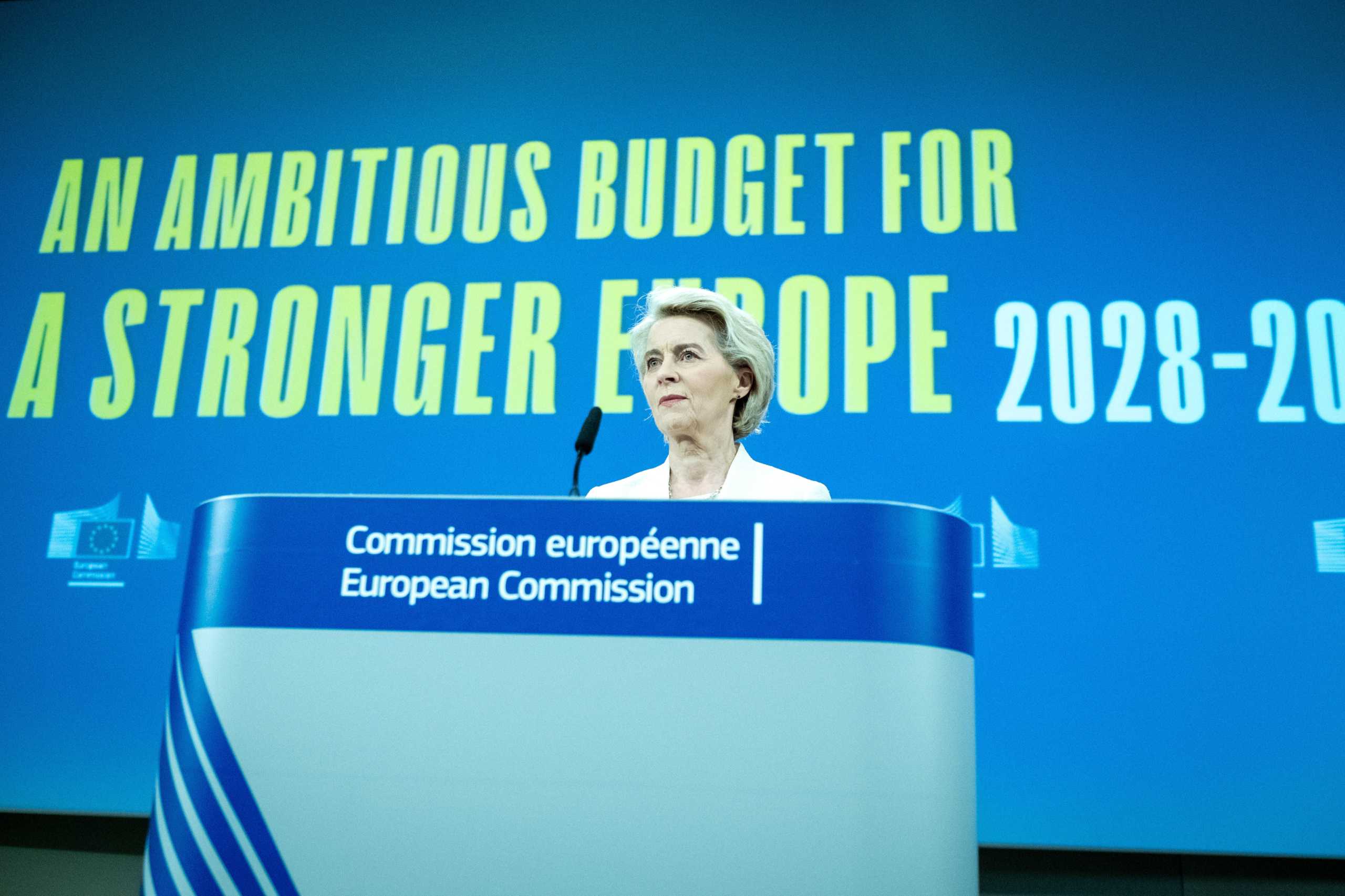
The MFF is the EU’s seven-year budget—and where any pledge on defence would have to show up in funds. The commission’s proposal for 2028–34 reflects such a commitment. It allocates €131bn to defence and space, roughly five times the current level, and puts security among the EU’s central priorities.
Out of the negotiating box
Commission proposals rarely emerge intact from negotiation, and early signs suggest this pattern may repeat itself.
Commission proposals rarely emerge intact from negotiation, however, and early signs suggest this pattern may repeat itself. Cyprus, which held the presidency until the end of June, left a negotiating box on how to structure the next MFF that envisioned reductions in defence and security while protecting cohesion policy and the Common Agricultural Policy (CAP). The box is the presidency’s draft compromise, the text the final deal is built from. The Irish presidency has opened with a strong focus on competitiveness and security, but Ireland leans heavily on farming too.
Budget negotiations are shaped by coalitions that defend long-established spending. The 16 member states of the “Friends of Cohesion” group, Spain, Italy and Poland among them, want robust funding for cohesion policy and agriculture, while frugal member states, such as Germany, the Netherlands and Sweden, are reluctant to expand the overall size of the EU budget. Defence enters as a comparative newcomer against policies with decades of institutional backing and organised constituencies behind them.
Germany’s position illustrates this dilemma. In a parliamentary inquiry, Alliance 90/The Greens asked the federal government how the EU can square four things at once: from 2028 it will need to start repaying NextGenerationEU, the €637bn joint borrowing agreed as a one-off in 2020 to fund members’ recovery from covid-19; forgo new revenue of its own (levies it collects directly rather than cheques from national treasuries); hold its budget roughly the same size; and still strengthen competitiveness, security and defence. The chancellor, Friedrich Merz, has repeatedly committed to the last three. The government answered that the EU could meet all three objectives by trimming across the whole budget. Yet such “horizontal cuts” only protect these priorities if all 27 members agree what to spare when deciding the cuts, and they are unlikely to agree. Other member states could favour different areas of the EU budget, cutting competitiveness or security harder than Germany intends.
New financing for a new era
The scale of investment required to deliver Europe’s defence transformation also exceeds what can realistically be financed through the MFF alone. While the seven-year budget can establish political priorities, provide long-term planning certainty and support common capability development, it cannot generate the sums required to finance Europe’s long-term defence.
Hence the appeal of joint EU borrowing: debt raised by the commission against member-state guarantees, the model already used for NextGenerationEU and SAFE. NextGenerationEU demonstrated that the EU can raise substantial resources when confronted with an existential crisis such as the covid-19 pandemic. Europe’s security has changed just as fundamentally, which makes the case for borrowing together just as strong. If defence is a collective problem, leaving the bill to strained national budgets makes little sense. However, borrowing on that scale is politically out of reach: creditor states intend NextGenerationEU to stay an exception rather than a template. Something narrower—bonds (or comparable fiscal mechanisms) that fund defence alone or the technologies Europe cannot do without may prove necessary if the EU wants to match its strategic ambitions with adequate financial resources.
Europe has accepted that it must carry more of its own defence. The MFF negotiations will show whether its budget can pay for it. With NATO entering a new era of European burden-sharing, the EU cannot afford a budget that reflects the priorities of a different geopolitical age. The world has moved on—it is time that frugal member states like Germany did so, too.