

It is only partly a coincidence that the tenth anniversary of the Brexit referendum—the event that provoked a toxic polarisation of British politics—was marked by another political casualty: the resignation of UK prime minister Keir Starmer.
Starmer is leaving with characteristic dignity, but without having delivered on the promise he made two years ago to revive the British economy. One key reason for his failure was Britain’s withdrawal from the EU. Just last week, a major study put the cost of Brexit at 6-8% of the UK’s GDP over the decade since the vote. Given such eye-watering costs, it should come as no surprise that the British public’s thinking about the relationship between the UK and continental Europe has undergone a quiet revolution since 2016.
To be sure, you wouldn’t know it from following intergovernmental negotiations or debates in the media. Politicians in London and across EU capitals insist that almost nothing has changed. Many of the faces are even the same. Nigel Farage’s Reform party is leading the polls in the UK, and the Labour government still refers to previous governments’ “red lines” vis-à-vis Europe.
Similarly, in Brussels, many still hold a hard line against allowing the UK to “cherry pick” the economic benefits of its proximity to the EU without assuming the obligations that come with membership. The desire to set an example by “punishing the UK” remains strong in some circles. Many European politicians describe Brexit as a “bad divorce” that will haunt them. They harbour resentments against those Britons who always saw the EU as a market rather than a political community. With so many other crises on their plate, they argue that Brexit has already occupied too much bandwidth, and they are wary of putting their fate in the hands of Britain’s fickle electorate ever again.
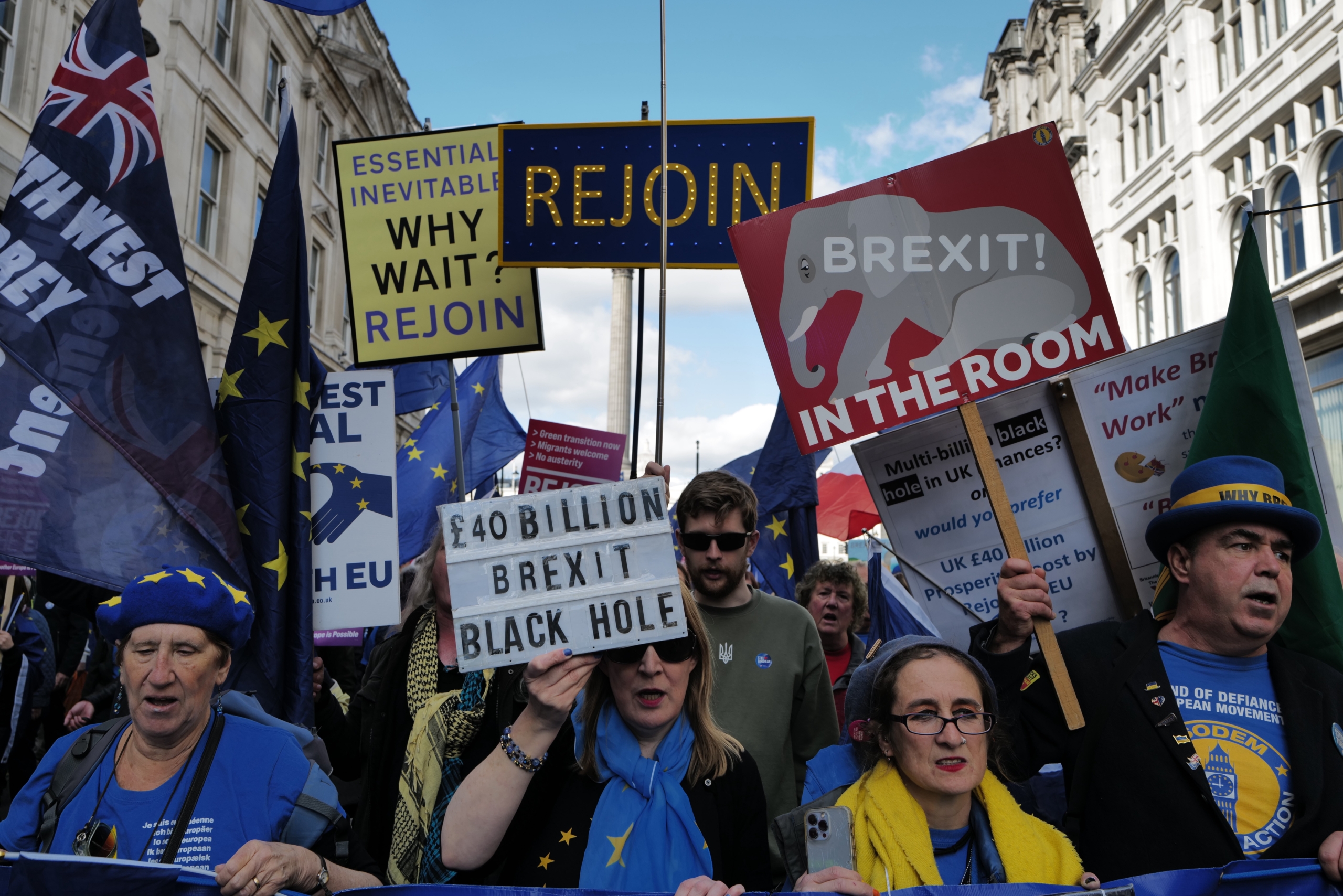
But while the elite debate remains the same, public opinion on both sides of the English Channel has undergone a remarkable shift. The change in the UK is especially dramatic. According to a poll conducted by my organisation, the European Council on Foreign Relations, the British public is thoroughly disillusioned with Brexit and thinks it has only exacerbated the country’s biggest problems, from the rising cost of living and illegal immigration to new security threats.
Some 75% of Britons want a closer relationship with Europe, and when asked to define what that means, the most popular choice is rejoining the EU
Some 75% of people want a closer relationship with Europe, and when asked to define what that means, the most popular choice is rejoining the EU. The desire to re-engage even cuts across the old leave-remain divide, with six out of ten “leave” voters expressing openness to a closer relationship.
The biggest gamechanger has been Donald Trump’s return to office. Faced with an unreliable US, large majorities of UK voters are looking to Europe rather than America to protect their economies, their security, and even their borders.
Britain’s party politics have changed as well. The 2016 Brexit vote created a crisis for the British Labour Party, because it split progressive voters and revealed a party that had no coherent alternative to offer. But now, the relationship with Europe is one of the few things that unites the old Labour coalition. Nine out of ten voters who left Labour for the Greens, and eight out of ten who defected to the Liberal Democrats, want to rejoin the EU. Even a plurality of the voters who left Labour for the far-right Reform party (the successor to the old Brexit party) say they would vote to rejoin the EU were a referendum held today.
That is why the big debate within Labour now is about abandoning the timid official line of seeking a mere “reset” with Europe. People want a fundamentally different option, and this demand may lead Labour to put EU membership back on the agenda.
On the EU side, Europeans—like the British public—recognise that Trump, Russian president Vladimir Putin and Chinese leader Xi Jinping have fundamentally changed the world for the worse. Rather than trying to make an example of the UK, they are asking how a new cross-channel relationship could serve their own security interests. They are thinking about what it will take to defend themselves when the US has disengaged and China is threatening them with de-industrialisation and strategic subordination. From Poland to Portugal, majorities in every country polled would like Britain to rejoin, and many believe the European Commission should soften its own red lines to foster a warmer relationship, especially on security.
And so, as we mark the referendum’s tenth anniversary, we should also try to close the European political rift that Brexit opened. Too much time has been wasted, and for nothing. On both sides of the channel, the public is demanding a new EU-UK relationship for the 2030s and 2040s. With Starmer’s resignation, Labour has an opportunity to renew its electoral coalition. And as European leaders like French president Emmanuel Macron focus on their own legacies, they should acknowledge that undoing the damage of Brexit would be a historic achievement.
If today’s leaders seize the opportunity that their voters are offering, the bad blood of the past decade will eventually come to look like a historical anomaly. But the political class must catch up with public opinion. Policymakers must recognise that Europe needs statesmanship, not cynical politicking. Forget the red lines. Europe needs to establish itself as a political community that can withstand the pressures of a new age of un-order.
This article was first published by Project Syndicate on June 23rd 2026