

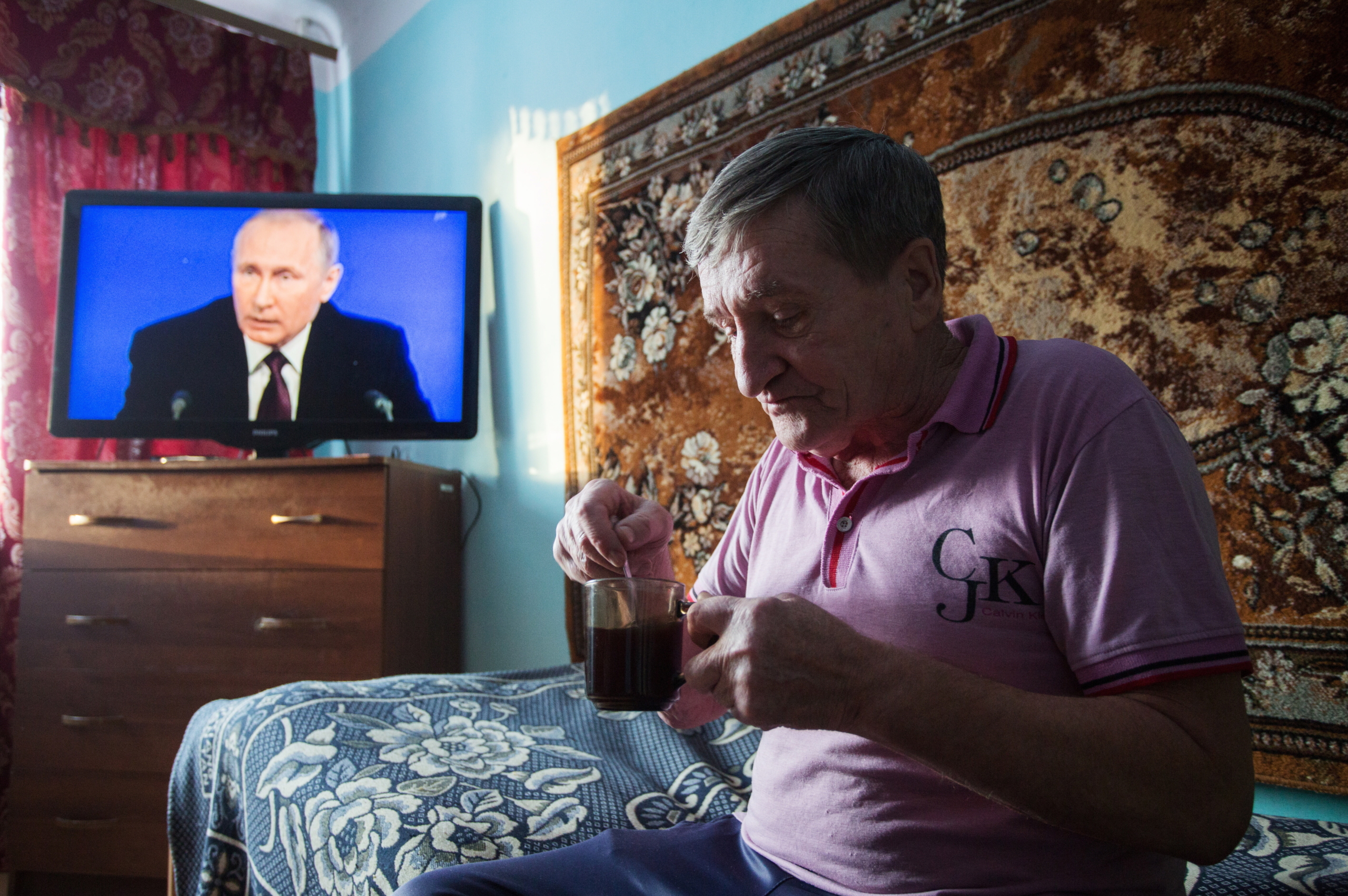
The invisible wall
“I don’t know why the Ukrainians hate us so much now. The West is just using them to fight us and weaken us.” ECFR focus group in Russia, June 2026
The Kremlin is known to expend great resource on studying Russia’s society. It regularly commissions polls and focus groups to help it present decisions in ways that are acceptable to the public, or at least tolerated. Occasionally it has even modified (although rarely changed the thrust of) its decisions out of concern for public opinion. While the Kremlin also has the capacity to shape public opinion, it knows it has limits, which it tries not to cross if possible. Russian society writ large has shown little inclination to oppose the war on Ukraine or other policies. But the regime is still careful to avoid giving people reasons to do so. It wants to know what Russians need, expect and desire.
To the extent that Europeans have an approach to Russian society, it is mostly the collateral damage of its other policies. Europeans fear a Russia dominant over Ukraine, with war coming ever closer to their borders. America’s unreliability as an ally means political leaders in Europe know they could end up facing Russia on their own. Over the last five years they have fortified their military presence on Europe’s eastern flank, erected an invisible wall of sanctions, severed economic and business ties, and limited people-to-people contacts.
Through the invisible wall, though, Russians can still see Europe. They follow the news and register political changes in Europe—with almost surprising astuteness, given the conditions of censorship in which they live. Europeans have no direct ways of communicating with the Russian population, but indirect ways remain: networks of exiles, media that cross borders, grassroots links that have not entirely disappeared. While Europe is right to prioritise security for the time being, it should also invest in these indirect forms of communication. Society in Russia is relatively educated and well structured, meaning that its members can change their minds about the world, Europe and their own country. Europeans, in turn, should make clear that they see Russia as a country that is not hopelessly condemned to being a dictatorship, but that is, when conditions allow, capable of something better.
This paper draws on public opinion surveys and on the insights generated by 14 focus groups conducted by research organisation Levada-Center in four big cities in Russia’s east, west, south and centre between April and August 2026. In all locations, separate conversations took place among representatives of different social groups—working-class people, small businesspeople and state employees. In addition, two groups brought together representatives of what can be termed the intellectual class, such as academics, teachers and people employed in the creative industries. All groups were gender-balanced (or close) and mixed in age, but all respondents were of working age. The sample does not include pensioners or students. The authors also draw academic research to complement this snapshot of where, in the fifth year of Russia’s full-scale war, Russian society is, what it makes of the West, and whom it perceives to be Russia’s enemies and friends.
The war
“The end of the war is not close. Maybe in the 2030s.” ECFR focus group in Russia, April 2026
The conversations take place from late spring to late summer—exactly when the war is becoming more acutely felt in Russia. Ukraine’s drone attacks deep inside Russian territory do not reach all regions. But the resulting petrol shortages and videos of blasts at Russia’s warehouses certainly do.
In the discussion groups, some admit to feeling greater anxiety on hearing the news. But this does not translate into panic or a change in attitude about the war more generally: almost no one expects it to end any time soon; and there is certainly no readiness to confront the Kremlin over it. (Moscow sociologists confirm the use of the word “war” is now quite common, in contrast to the earlier stages of the conflict when “special military operation” dominated.)
Overall, across the groups it is clear that Russians treat the war as a given; a reality they cannot change. Most assume Russia will prevail by virtue of its size and power and want their country to win out of national pride. But nothing in the discussions suggests people look on the conflict as an existentially important battle or a noble fight. When asked if victory in this war will be more important than victory in the second world war, the unanimous answer in all the groups is: “Of course not.”
One senses that people treat the war as something inconvenient, even shameful, that sparks no pride or enthusiasm. Still, such views pose little problem for the Kremlin. In fact, while the “special military operation” is very important for the regime, it would face a different type of problem were society to follow the lead of Russian nationalists and invest the Ukraine war with the sacredness it does the second world war (or the “great patriotic war”, as Russians call the period from June 1941 to May 1945).
At the same time, people seem resigned to the war dragging on for some time. When asked to name its likely end date, participants overwhelmingly suggest it will last another two or three years. A few others guess well into the 2030s, or even longer. In several groups it is assumed that the war in Ukraine will become a forever war, not unlike the Soviet Union’s invasion of Afghanistan.
While no one expects Russia to lose, equally no one is sure how the war will end. They are also unsure what victory would look like. “Ukraine will come to its senses and stop fighting …”; “Russia will keep the territory it controls …”; “Half of Ukraine will come to us …”; “Maybe Russia will take more territory, open a passage to the sea …”; “Ukraine will have a new president who is friendly towards Russia …” Confidence is common in Russia’s status as a great power and its own legacy of resilience: “Before attacking Russia and engaging in conflict—something everyone has tried to do throughout centuries of history—people simply fail to grasp that, yes, we hide beneath the ice, yes, in a frost, and nonetheless we will prevail.”
When asked why the war began, people have to think for a second before answering. Overall, their opinions are defensive. A number of people try to describe it as a “necessary” or “preventative” step, or suggest Russia was provoked. In polls taken in 2022, people were asked why Russia started the “special military operation”—and a plurality assumed it was to defend the people of Donetsk and Luhansk, and thus Russia’s choice to start the conflict. This explanation appears to have all but vanished. “If Russia had not hit first, they [the West, NATO or Ukraine] would have attacked” is a narrative numerous participants offer. For most, though, the causes of the war remain hard to understand. A range of differing suggestions are forthcoming: “Europe’s pressure on Ukraine”; “the Western-orientated leadership of the country that started bombing Donbas”; “Ukraine becoming a failed state when its president [Viktor Yanukovych] escaped”; “Nazism in Ukraine”; but also “a small victorious war that did not go as planned.”
It also seems unclear whom Russia is actually fighting. While some respondents state Ukraine is the adversary, for many the picture is foggier. The adversary is sometimes bigger than Ukraine—such as the West making use of Ukraine to fight Russia—or smaller, for instance, “Nazi paramilitaries in Ukraine”.
With the aims of the war poorly understood, it becomes impossible to say what success would look like. It is harder to know if you have won if you do not know why you are fighting. Some people are eager to point this out: “We do not know the aims [of the war]! I would need to know the goals to pass judgment”, one woman says repeatedly. Such views are in fact convenient for the Kremlin—they leave the regime the space to define “victory” in whatever way it wishes. It is also evident that people are aware of this: “We will accept anything the higher-ups define as victory”, says another woman.
The cost
There is also a sense that victory for Russia will bring little by way of happy news, even if people are certain it will happen. It will not make life better. Participants seem conscious that the reconstruction of Ukraine will cost huge sums. They accept that, as far as areas controlled by Russia are concerned, the money will come from Russia’s budget and at the expense of domestic social spending. “I can see that financing of social sphere, including health care, is decreasing”, says one. While some expect the end of the war to result in the lifting of Western sanctions, others acknowledge that sanctions will stay—and that Russia will be regarded as a pariah for years to come. “There is also a reputational cost,” remarks one man. “Our country has found itself in the position of an outcast. And there are reasons for that.”
Some remark that Russia will pay a steep price. “The country will not be able to develop normally”, says one participant. She continues: “The young, the students—people who could dedicate their life to Russia and do lots of good, they no longer view their future in Russia. This war left Russia without a future.” “I have a daughter who is growing up and it’s quite important to me what kind of a gene pool she carries forward”, says another participant, a mother who worries that too many young Russian males will die, leaving women with the choice of staying single or marrying an immigrant. Optimism is scarce. “Russia will expand its territory, and I think this will bring us new opportunities”, says one man. But his statement is met with no enthusiasm by others in his group.
What everyone feels and complains about is inflation. In some focus groups, long and emotional discussions take place about the cost of living; about how young people in particular are unable to get an apartment. But they do not blame the war for these problems. Even if they make the connection on some level, it does not induce them to oppose the war. Instead, people accept they simply need to put up with things. “Need to work more and spend less”, says one man. “I think—in winter skis, in the summer—mountains and sea, but all other times—alcohol”, says another, when asked how to manage.
There is also a sense that things could get worse, including after the September Duma election, with people assuming the Kremlin might then take unpopular steps like intensifying military mobilisation. Men in the groups—asked if they would join the war—usually reply they would decline (“not for any money!”). But many also admit they would consider it their duty to comply if mobilisation was announced. The women worry about their children and relatives, or—in the case of teachers—about their students.
When asked whether the war could go beyond its current theatre and involve an attack on another neighbour, or even become a NATO-Russia conflict, people are sceptical. They acknowledge they have no idea what the Kremlin will do, but they generally do not expect the war to widen or spill over to other theatres. There is certainly no demand for a broader escalation. “We will not go there, I do not understand why we would, we are not idiots”, concludes one participant when asked about a potential attack on the Baltic countries. Others in the group agree.
Veterans
A striking feature across all groups is a lack of compassion for others, be it towards Ukrainians or fellow Russians sent to fight. And, although some express worries about family members getting conscripted, this does not translate into sympathy for those at the front now. In fact, people dread the return of veterans, fearing new violence at home. Some participants share stories of unpleasant encounters in local grocery or alcohol stores with those back from the fighting. The veterans of the second world war have always been glorified, and not just by officialdom. But the people taking part in the discussions directly compare the veterans of the Ukraine war to those who fought in Afghanistan (a war officially disowned by the Soviet regime in 1989) and who became associated with criminality. Such attitudes run counter to the regime’s current propaganda and statements from the Kremlin, which hail the veterans as the “vanguard of Russia’s patriots” and a new elite. This view does not appear to find favour among the population.
Ukraine
“If we dig back to 1945 and look at the Bandera regime then, by and large, we are at war with Europe—with the Germany that left its Nazi roots on Ukrainian soil.” ECFR focus group in Russia, April 2026
When asked if Ukraine is a sovereign country, very few reply with a firm “Yes”. Most say it is not sovereign, or not fully so—if Ukraine is mentioned among the adversaries, it is usually the “Ukrainian regime”, not the country. There is a recognition that Ukraine became a full-fledged, independent state in 1991; but, after that, people believe something happened that caused it to lose sovereignty. They struggle to explain what precisely this was: “A coup took place …”; “They started glorifying Nazis …”; “They became anti-Russian …”; “Europe pays for everything there …”
The views aired suggest that the war and its causes are tightly bound up with Ukraine’s status—or rather, how people perceive its status. If Ukraine fails to qualify as a fully sovereign country, this perhaps makes the war more palatable for those who hold this view. By such logic, a proper war could happen against a proper country; if the adversary is not a proper country, then that is not a proper war. This lowers the temperature of the whole situation, or at least it does on the Russian side of the border. It may also numb people to the suffering the war is causing.
Views about Ukraine’s leadership are overwhelmingly derogatory. Most groups were asked to compare world leaders—Vladimir Putin, Donald Trump, Xi Jinping and Volodymyr Zelensky—to plants and animals. While the first three receive a range of metaphors, Zelensky is often compared to rats or mice—something small and not necessarily pleasant. The nature of the metaphors is similar even in the one group that turns out to be overwhelmingly critical of the war. Here, people opt for hedgehogs, grass or podorozhnik (broadleaf plantain) in aid of describing things that are small, but resilient; that might get trampled but still come through.
The world beyond: Friends
“In fact, our situation is not funny: we have enemies which are very strong politically, economically and materially. And our friends and allies are weak.” ECFR focus group in Russia, April 2026
All groups were asked which countries they consider Russia’s friends in the world. The roster of countries they mention is not surprising: it includes Cuba, Iran, North Korea, Serbia and Venezuela; sometimes also Brazil and India, sometimes Indonesia and the Philippines. People are remarkably well informed about political shifts in other countries: “Hungary used to be an ally, but no more” is a common refrain. China and Belarus always occupy the top of the list. Still, these two countries are viewed very differently. It is understood that Belarus has no choice: “Belarus is a friend, of course—they’re dependent on us”, explains one man.
As for China, the relationship clearly has its limits: people see it as an ally pursuing its own agenda, and believe its long-term interests might not coincide with those of Russia. They comment that business deals agreed between the two countries are skewed to benefit China; many think that China sees Russia as a source of raw materials: “They buy timber from us and then sell us furniture made of sawdust”, remarks one respondent. People are clear that the alliance, such as it is, is rooted first and foremost in joint antagonism towards America and the West; and, even here, China stands to benefit most. While Russia and the West weaken themselves by fighting over Ukraine, China bides its time and is only getting stronger. “They say that a ‘zero hour’ will arrive—the moment it arrives, the Chinese will start popping out from everywhere: from boxes, some from behind the TV, others from the refrigerator in countries all over the world”, quips one respondent. The relationship is seen not as an alliance of choice but one of necessity.
Many also think China is smarter than Russia, and better at long-term strategy. People are asked to imagine world leaders in different situations. “If Putin plays chess with Trump, who would win?” “Putin”, is the usual answer. “But if Putin plays with Xi?”, “Xi would win”. Another game involves Putin, Trump, Xi and Zelensky stranded together on a desert island. That is more of a stretch of the imagination, and no group has unanimity on what exactly would happen. But never do they say that Xi would end up worst off in such a scenario.
The “turn to Eurasia”—a plank of Russian foreign policy since Putin returned to the presidency in 2012—appears to have gained no traction. People know that the relationship with the West has soured. But they see states to their east as allies of convenience, and neither culturally nor historically close to Russia. When asked where their country belongs, very few think its destiny is to be in Asia. “If we survive, we will most likely be Europe”, says one man. “Maybe a new Europe.”
The world beyond: Enemies
“In Europe, they all believe that it was Putin who started the war and that we are the ones to blame for everything.” ECFR focus group in Russia, May 2026
If the list of Russia’s allies is quite short, the list of unfriendly states is long. “Well—everyone else”, is often the first reply. The bigger European countries—Britain, France and Germany—are usually named first, followed by the Baltic states, Finland and Poland; sometimes also countries like India and Turkey. NATO is an enemy too, for most respondents—one explains that it is because “NATO keeps encroaching on other countries to bring about so-called democracy with bombs.” Ukraine is mentioned, but not as a first choice and somewhat hesitantly—not because it is not seen as an enemy, but because, as explored above, Russians might not regard it as a proper country. And even where it is mentioned, few participants connect its “enemy” status to Russia’s own invasion of Ukraine.
When asked what the US is like, people’s immediate answer is often that “it is different; it is many things.” Some focus on what attracts them about America: science, possibilities to develop, good music and cinema (“we are very far behind”), skilful marketing (“they know how to present themselves”), opportunities for talented people, legality of weapons, individualism and privacy (“Putin cannot walk into your apartment!”). Afterwards, greed, cynicism and freedoms are named too.
Remarkably, the Trump presidency has shifted the US from its status as Russia’s arch-enemy—the position it has occupied most of this century. “There were very high hopes that Trump would finish the war”, a Moscow sociologist explains. “People felt that this war is very hard to end. It would take extraordinary powers—and Trump seemed to possess those.” And, while enthusiasm waned as weeks and months went by, the status of the US did not return to what it had been. Now Europe occupies the role of the enemy-in-chief.
Europe’s image seems in many ways in sync with the Kremlin’s own rhetoric. People criticise it for “gay parades”, for “women at the helm”, for didactic lecturing. In some groups, people get into exchanges about Europe’s decline: some maintain Europe is withering away, pointing to pride marches and migrants as proof. Others point out that many states want to join the EU just to benefit from Germany’s or France’s economic might, or because they would otherwise be weaker on their own: “To me, all these countries are, you know, like cockroaches. If they scattered, they wouldn’t amount to anything—at least, that’s how it seems to me. It’s easier for them to stick together in a bunch”, says a man in one group. Others argue against this position: “Europe has more money than we will ever have! Decline is a propaganda narrative.” The first associations that respondents make with Europe are almost always negative. As an afterthought, though, rule of law, social security, beauty, history and freedoms also come to mind. Overall, public opinion polls show general attitudes towards Europe are worse than those towards America and almost on a par with views of Ukraine.
Despite these clear associations, people struggle to explain why the West—and Europe in particular—has become an enemy. When prompted, most people remember the West was seen as a friend and a role model in the 1990s and early 2000s. But they are often at a loss to explain when this changed. “They started putting pressure on other countries, such as Ukraine …” and “They have never loved us …” are answers people clutch at.
One woman returns to the question at the very end of the conversation, wanting to share her puzzlement: “I now started to think—indeed, why are there now coalitions against Russia everywhere …? That did not use to be the case …” Almost no one connects the perceived European “antagonism” to Russia with Europe’s reaction to Putin’s invasion of Ukraine or any other actions by Russia. “I don’t know why the Finns are so antagonistic to us. Maybe they never got over the fact that we took over Karelia in 1940”, opines one respondent. Others complain about their positive attitude towards the Baltic states and these states’ negative attitude towards Russia: “I don’t know why they [the Baltic states] are so adversarial, most probably they were ordered to be like that”, concludes another participant. Confusion, propaganda, wilful ignorance and lack of curiosity probably all play their role in shaping Russians’ perceptions of their country and its external relations. And it also helps explain why the war in Ukraine still seems distant to many in Russia—and why Europe’s own reaction to the war is overwhelmingly seen as negative, almost unfair.
This brings to mind a conversation held by one of the authors with a Moscow sociologist long before the war. Explaining how the Russian people form opinions about the West, the scholar noted that Russia’s own role tends to get forgotten. “For instance, Russia invades Georgia—there is some outcry, then the West imposes sanctions, and soon the population will have decided that the hostile West has attacked Russia with sanctions. That something happened that led to it, that Russia did something—that is soon overlooked. People settle on the opinion that these small countries do not really matter, no one very much needs them, this is all about the West’s competition with Russia.” Some participants in the focus groups echo this: “On what basis is the US even imposing sanctions on us?!” asks one puzzled respondent.
But, when it comes to the future, the expectation remains that relations with Europe will get better. And, despite Europe’s newly acquired hostile image, people seem to assume that things are more likely to improve with Europe than with the US (even though some people still mention that America could help to end the war). When to expect this is vague: “During Putin’s rule, nothing will change. After his departure things can change, also as concerns relations with neighbours”, remarks one participant. And the improvement, should it happen, will be a pragmatic one: “They’ll again start buying things from us … business logic will prevail.” No one across the groups expects Russia to look on Europe as a role model again.
People’s personal experiences matter: those who have visited the West, even if long before the war, have formed opinions based on what they saw and heard. These people often make statements that diverge from widespread narratives, or the toolbox offered by state propaganda. “I had a guest from Lithuania recently, we had long talks”, says a woman, when asked if Russia will be friends with Europe again. “They are all afraid of us, expecting the worst—what friendship?!” “I have been to Finland”, says another. “They remember 1939. That’s that. They are always ready for war. They will not attack us, but they will not let themselves be pushed around.”
In another group, one man seems to have visited most history museums in eastern Europe. He suggests a new generation is growing up that has forgotten the old times and views Russia with deep suspicion. “In Vilnius, there is museum of Soviet occupation in the city centre, all the young people visit it, they soak up that information. They will not turn towards Russia.”
Bewitched sleep
“People do not think, because they are preoccupied with how to feed the family, how to survive. They have a simple schedule: home, work, home. Or home, work, grocery store, home. That’s all.” ECFR focus group in Russia, April 2026
Perhaps the most interesting and touching moment of the focus groups always comes towards the end when people start to reflect on the conversations they have just had—with a Levada-Center scholar and a group of strangers. Was the conversation important, and what about it was important? Most acknowledge, with some surprise, that these questions rarely cross their minds. “When the special military operation was mentioned, I first thought—‘What?!’ But then I realised that it is as if it does not exist. It is buried so deep that you do not allow yourself to think about it”, says one. All her fellow participants agree.
What does this show? It shows that people are in fact worried about their own future: that of their country, what next in the world, what next in the war. But only when the question is put to them do they realise they are scared. They say they feel things are gloomier than they used to be and they worry about Russia’s lack of friends. Life has changed.
This is not explicable solely by fear of repression by the regime. Rather, it seems that the nature of social interactions—what people talk about, what they avoid, where and how—has changed. People feel that they lack agency, that they cannot do anything about such matters. So, even if some of them care, it becomes pointless to even discuss these questions. Instead, they escape into everyday life and task themselves with the survival of the family. People sink, often voluntarily, into what might be described as a “bewitched sleep”—seeking to shut out the winds howling round the house, including policies that are hard to change, even though they affect everyone. Such “sleep” has been characteristic of Russian society throughout Putin’s era, reflected in the remarkable stability of opinion, for instance, on Putin’s own approval rating, which has never dropped below 59%. The war may be testing this; but so far there has been no dramatic awakening.
However, some Russians refuse to slip into this bewitched sleep. They feel the tragedy of the situation most keenly and suffer as a result. In most focus groups at least one person, sometimes several, holds pronounced anti-war views—a take on events that diverges from the mainstream. But in one group such people turn out to be a majority; and there the conversation reaches very dark conclusions indeed.
“This war has destroyed some very longstanding things. For me this war has spoiled the whole memory of the second world war”, one woman confesses. “The heroism of the people, the stories, the memories—they used to matter to me, but now I no longer can relate to them in the same way, as they have been used to justify this war. I no longer can listen to the songs, to think about the war as before.” “For me, the closure of [human rights organisation] Memorial was the most unbearable event from the recent past”, says another participant, continuing: “I understood that this will lead to a catastrophe. You cannot hide memory under a carpet.” “I really loved vyshivanka [Ukrainian embroidery]—but I feel I no longer can wear it, because I have no right to”, laments a third.
“People have become quiet, sad and very hostile”, comments one, describing the impact of the war. “It is hard to understand what kind of future we can have after this.” “What used to be a bad tone, unacceptable behaviour, that is now possible and ubiquitous”, a man says. “Everyday rudenesses have become normal and acceptable.”
The non-sleepers also stand out when asked to draw a picture of the future showing the world, Russia and themselves. All groups complete this task, and the results are mixed: some depict just the sun, a house and a person; some sketch out a Russia whose enlarged borders overshadow neighbours; some conjure up fearful images of war. But, with alarming frequency, non-sleepers draw barbed wire, graveyards and concentration camps.
For all, the focus groups turn out to be a rare chance to speak about these matters—for sleepers, because they never normally focus on them; for non-sleepers, because they feel that they are on their own; they do not know like-minded people, and they never initiate such conversations.
*
In her novel “Sweet Darusya”, the Ukrainian writer Maria Matios describes life in a Bukowina village divided by a river during the first half of the 20th century. Power changed hands frequently, and it sometimes happened that one half of the village had different rulers to the other. When the Bolsheviks first conquered one side of the river, the other side, still in Romania, began to look on in astonishment: life across the river appeared to go on as before. People worked in the fields, tended cattle, baked bread … but things had become somehow very quiet. Parties, fairs and gatherings had stopped, even arguments seemed never to happen; hardly any noise carried across the water. A year later, the Bolsheviks crossed over. Suddenly, people understood why so much had gone still. Now exactly the same kind of quiet settled over them, too.
Listening to the words of these Russians in the focus groups brought this story to mind. Daily life goes on as normal, or almost so—against the background of Putin’s invasion of Ukraine and with the experience of rising inflation, petrol shortages and rapid expansion of cemeteries. But underneath it all is a deep, uneasy silence that envelops things people do not allow themselves to think about or discuss even with those close to them.
If Russian society is in a state of bewitched sleep—demonstrated by numerous opinion polls and underlined by these focus groups—how should the West react? Can anything be done to rouse the slumberers? And what does this mean for Europe’s own interests?
It would be a stretch to draw too many recommendations based on a series of focus groups and opinion polls. But some initial conclusions suggest themselves.
Things in Russia are static, but there is a sense something is “off”
Both the focus groups and available public opinion polls show that, while the majority (61%) of Russians think it is time for peace negotiations, they appear set to allow things to carry on and hope for the best in terms of their own economic situation. They may be unhappy about the “special military operation” but see themselves as having no agency to influence it. A majority (59%) also thinks that, if peace cannot be achieved yet, then it would be appropriate to intensify attacks, as opposed to offering more concessions to Ukraine. Most seem to agree peace must be on Russia’s terms.
Furthermore, the regime’s justifications for the war appear to have been mostly accepted. In the words of one Russian scholar, this is not because the Kremlin can simply foist its narratives onto society—it is because these are crafted in a way that resonates with opinions that are already present in that society.[1] In other words, propaganda is not a one-way street—opinions, biases and stereotypes already present among the Russian public inspire and reinforce the regime’s own narratives. Inflation and economic and logistics problems may continue to grow, and society and business are certainly feeling the pain. But, for now, this does not translate into panic or a protest movement that could limit or challenge the regime’s actions. As the same Moscow scholar remarks, “Society ceased to perceive itself as a political actor a while ago—one of the achievements of Putin’s regime. There is no reason to believe that this is about to change any time soon.”
Yet it is not impossible that social or political change could emerge from this funk. Just as few predicted the erosion and collapse of communism in the Soviet Union, it is hard to see what exactly might decide Russia’s future course—be it the worsening economy, the growing anxiety among Russian elites, the absence of decisive results on the battlefield, an eventual leadership change or something different altogether. When that could happen is also unclear. But what both the focus groups and the opinion polls suggest is something a sociologist with decades-long experience in studying Russia describes as follows: “Something is ‘off’. We can’t pinpoint what exactly it is, but something is indeed off.” In some focus groups, participants echo the feeling: “There is a sense that soon something will blow up”, says one man, while others quietly nod. The sleep may be bewitched, but no one knows who will break the spell. Once it lifts, people’s opinions will become even more important—and the West needs to be ready.
Reaching the Russians
Next is a question about Western—Europe and America—actions vis-à-vis Russian society. Russia, after all, will continue to be Europe’s neighbour and a nuclear power. Even authoritarian leaders need to pay attention to the society they seek to govern—so the mood and thoughts of Russian society will have implications for any future leadership of the country as well, not just the current regime.
Nor is it possible to fully isolate Russian society from Europe, as some argue should be done in various sectors. In recent years, Western governments have sanctioned Russian businesses, restricted cultural exchanges, expelled diplomats, screened investment and curtailed official contacts. But societal interaction has not disappeared. Some Russian tourists still go to Europe—a number of focus group participants had visited relatively recently. Students continue to enrol in Western universities, independent journalists work from exile and Russian disinformation still reaches Western audiences. Many European countries host sizeable Russian diasporas; and the countries bordering Russia need to handle the movement of people and other border issues—with all its risks—on a daily basis. Contact persists, even though it does not seem to directly lead to a greater embrace of Europe’s opinions about the war in Ukraine or adoption of other European views.
There will inevitably be limits to Western ambitions to shape Russian opinion. Any such attempts need to be rooted in realism about what the West, or at least Europe, can actually achieve. Even during Russia’s greater openness in the 1990s, no one in the West had a direct line to the whole of its society. Messages have always passed through a filter of state media, local opinion leaders or domestic politics. (Think, for instance, of 1996, when the Kremlin, state media and the West wanted to support Boris Yeltsin’s re-election as Russia’s president, but the bulk of the population likely favoured the Communists.)
With these limitations and restrictions in mind, are there ways for the West to shape the opinion of Russians more actively? This would apply especially to European countries and the EU institutions, given that the current US administration prefers direct engagement with the Kremlin. America has also folded its USAID programming, which previously supported civil society organisations, independent media, education and community initiatives inside, and for, Russia.
The following opportunities exist.
Convey shared values instead of blanket generalisations
Labelling all Russians as aggressors—especially if done by political leaders in loud statements—hardly helps; it only reinforces biases and serves the regime’s own propaganda, while creating a feeling of global isolation in the minority of people who firmly oppose the war. Universal values still matter. Russian citizens, too, deserve peace, human rights, fundamental freedoms and democratic values, even if almost half of the population may not hold them. It is therefore still worth supporting initiatives in Russia which strive to enact these values, such as Memorial.
Western—especially European—language about Russia should therefore be rooted in protection of fundamental values rather than in mere opposition to an authoritarian regime or to the whole of Russia. This approach is unlikely to produce quick results. But it would be a morale boost to the non-sleeping minority in Russia; a signal that, even in the conditions of a dangerous stand-off, Western democracies remain upholders of universal values.
Admittedly, talk of values will be much more powerful, including in the eyes of Russians, if Western societies manage to renew their own models of democracy. If their democracies start to produce strong majorities to meet the challenges and crises of the age, this will not go unnoticed in Russia. As our focus groups demonstrate, Russians follow the news keenly. Any bigger shifts in European politics—for instance, changes of government and policy direction in Hungary or Germany’s recent state elections—will have been noticed. If democracies become strong and successful, this will shape perceptions of the West in Russia as well.
Support authentic voices inside and outside Russia—and those who amplify them
Figures connected to Russian society, both at home and from abroad, are important and authentic voices for various parts of society. They need greater support, whether financial, social or political, because they can reach the sleepers in Russia in a way few Western actors credibly can. This applies both to Russian exile media and, even more importantly, to those organisations and initiatives still inside Russia. Whether at grassroots, community or national level, their work helps cultivate a sense of agency among people—that their voices, choices and preferences matter. There are different actors, different exile groups—media outlets, intellectuals, cultural figures. It is unclear what reach they have or can realistically have in Russia’s deep backwater (glubinka), but they are followed by the intellectual class of the country. News and ideas can thus trickle out from them to wider society. In a country like Russia, which is organised in a top-down manner, and where the intelligentsia is relatively small per capita, such voices can still be influential, especially at critical times.
Reduced American funding for democracy and media initiatives means Europeans may need to contribute an even bigger share of support for Russian-language independent media. The community of Russian speakers across the world is far bigger than just Putin’s supporters—this information space should not be vacated for the Kremlin. Universities in exile and their students should also receive greater practical (financial or social) support—they are not just Russia’s non-sleepers, but those who dream of a better Russia. Each of these students has friends and family inside Russia, and each can reach others who may otherwise prefer blissful sleep. Similarly, European governments and donors should continue and extend help for Russia’s exiled novelists, literary and artistic figures—their unique way of communicating with audiences back in Russia can connect with many of those who have already tuned out from politics.
Draw up communications efforts appropriate for each European country
In these efforts, the West will face inevitable constraints. The most obvious is to avoid working with those partners who directly undermine universal values and European or American key security interests—or who support voices that do so inside Russia. The same goes for the war in Ukraine; those who actively endorse it or aid it are unlikely to be persuaded through Western outreach and engagement. Moreover, working with actors inside Russia or exiled organisations and individuals always carries a risk, given the regime’s repressive apparatus, authoritarian legal framework and considerable risks to those individuals’ and communities’ personal freedom. For the West, such cooperation is also far from hazard-free: trusted people may turn out to be regime collaborators or a security risk.
Yet not all countries need to adopt the same policies when it comes to Russian exiles. This is especially the case in Europe, which accepted many more Russians who left their country in the wake of Putin’s invasion than did America—where the Trump administration deems Russia a regional, rather than existential, threat.
While coordinating European approaches to Russian exiles at the EU level is prudent, uniformity is not. Structural differences persist, determined by geography, historical experience and different levels of exposure to Moscow’s own pressure campaigns. Estonia is drawing up contingency plans for a possible land invasion by Russia and voted to strip resident Russians of the right to vote in local elections. France and Italy face cyber-attacks and information operations more than kinetic threats from Russia. Poland, Romania and others (including, more recently, Germany) have experienced sabotage and drone incursions. For Estonia or Poland, the question of Russia and Russians—and related security risks—will always be more sensitive than, for instance, in Italy or Spain. Russians may be asked to bend over backwards to prove their loyalty in one part of Europe—but may feel much more welcome elsewhere in the EU; and it is fine for Russian exile organisations to seek refuge among the latter set of countries.
Deliberate hope
In these rich conversations, many Russians refer to their own personal experiences and conversations in Western countries. Without exception, these are much more positive and better rooted in reality than the views picked up from state television. Grassroots communication and interaction—people meeting and talking with others—really works. European decision-makers should bear this closely in mind, alongside the risks, when shaping aspects of Russia policy.
Some of this will come about independently of officialdom: people find a way, and new patterns of interaction emerge regardless. The choice is whether Western governments decide to shape that interaction deliberately, according to their strategic interests and values, or allow it to develop piecemeal—or, worse, on terms set by the Kremlin. The realistic near-term ambition may be fairly narrow: to influence those limited interactions that exist. But the possibility of a transformed Russia can be kept alive, on clear conditions and without illusion, only if the contact that already exists is governed with deliberation rather than surrendered to chance.
How Europeans can communicate with Russian society, and key risks and safeguards
| Channel for interaction | Risks to watch out for | Safeguards to mitigate risks |
| Students, researchers and universities in exile | Today’s students as tomorrow’s spies; Western scholars face deportations, entry bans and criminal cases; hostage risk inside Russia | Concentrate on non-sensitive disciplines; use admissions to maintain integrity and security; decide upfront whether to build returnees or retain talent |
| Culture and media | Priorities and resource allocation while Russia bombs Ukraine; asymmetric access lets propaganda outlets exploit open media, though the Russian public remains enthusiastic about Western films | Support independent Russian-language media and initiatives at local and grassroots level; support exiled media, artists and literary figures; build audience media literacy; deny Western accreditation to state propaganda outlets |
| NGOs and civil society | Foreign-agent labels and criminal liability expose partners; associating apolitical causes such as the fight against domestic violence or environmental initiatives with a Western agenda | Give low-key support to organisations and initiatives; avoid exposing partners; support flexible mechanisms where possible |
| Science | Dual-use and security leakage in sensitive areas; social sciences politically exposed | Concentrate on low-sensitivity common interests (such as medicine and climate); protect fieldwork security; keep investing in Russian expertise |
Acknowledgments
The authors would like to thank all those who directly or indirectly facilitated and conducted the focus groups across Russia, as well as the individuals who took part and were willing to share their views with Levada-Center. In what Russia has become today, this is not a given—but the insights were invaluable to us. Throughout our research, we have had enriching conversations with sociologists and political scientists who have been lifelong students of Russian politics and public opinion. They helped us separate the signal from the noise and bring out the most relevant insights.
Early presentations of these findings for some of the Russia watchers in Berlin, Vienna and Washington, DC generated valuable feedback, as did exchanges with our colleagues Jeremy Shapiro, Marta Prochwicz-Jazowska, Jeremy Cliffe and Nicu Popescu. Sabine Fischer, Matthew Rojansky and Samuel Greene helped to brainstorm the questions we wanted to ask of Russian society. Adam Harrison’s wondrous editing skills improved our drafts and our arguments; Chris Eichberger’s and Nastassia Zenovich’s talents helped us bring the illustrations and quotes from the focus groups to our readers. We also want to thank Marie Dumoulin for her earlier work on the subject. Having mentioned various inputs and contributions, the final content of the paper is the authors’ responsibility alone. This paper is part of a project on the future relationship between the West and Russia. The authors are grateful to the Andrew Carnegie Foundation for the support and patience that made this work possible.
About the authors
Jana Kobzová is co-director of the European Security Programme and senior policy fellow at the European Council on Foreign Relations.
Kadri Liik is an associate fellow with the European Council on Foreign Relations.
[1] Telephone interview with author, August 17th 2026.