

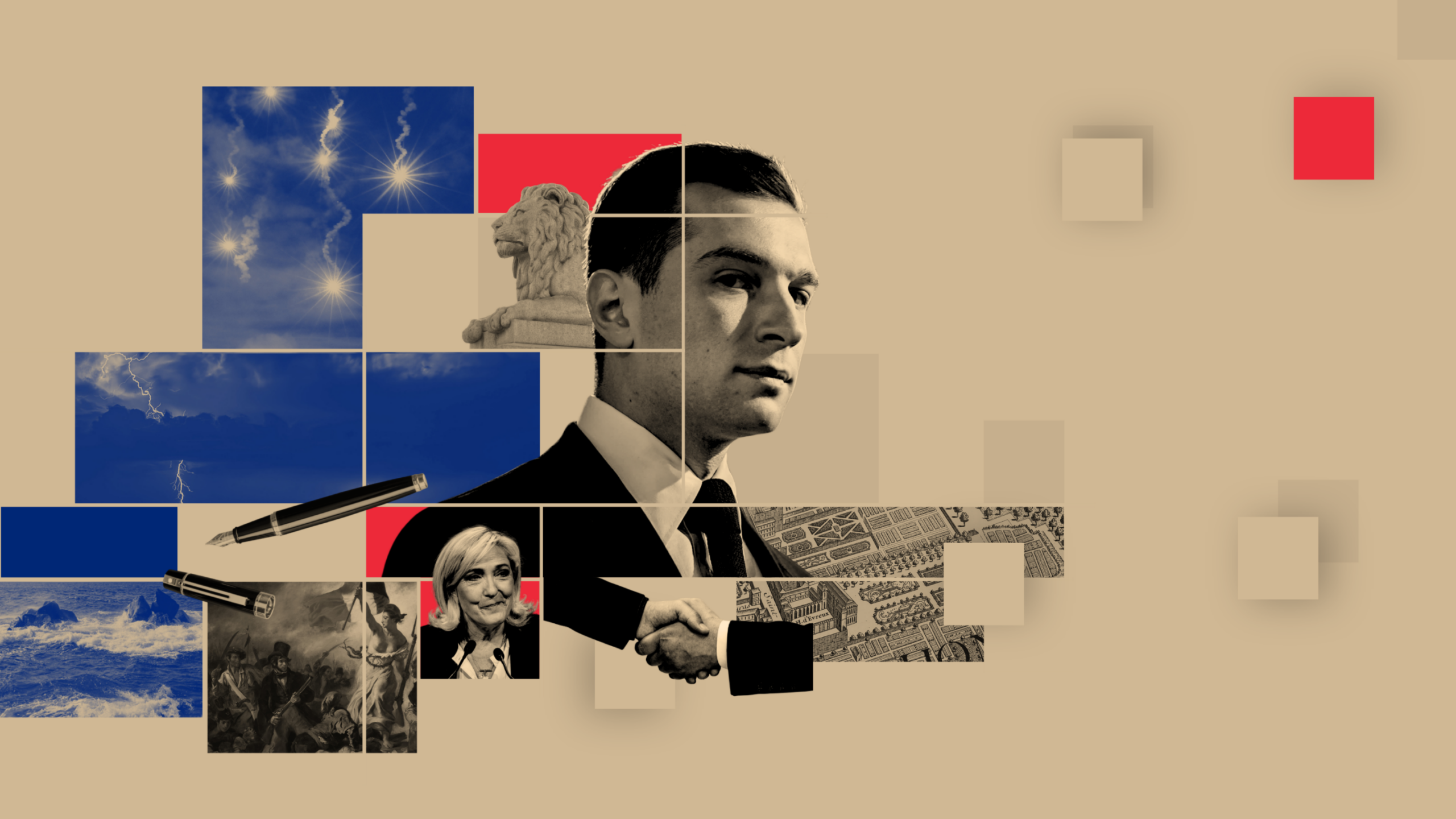
President-elect Bardella
May 2nd 2027, Paris
Tricolours fluttered in the warm night air as Jordan Bardella’s convoy of cars swept across the cobbles of the Place de la Concorde. At only 31 he had just been elected France’s president, making him the country’s youngest leader since Napoleon. Ascending to the podium, he took in the adulation of his supporters before beginning his victory speech.
“Monsieur Philippe has graciously congratulated me on being elected the next president of the French Republic,” he told the crowd of slick-haired young men, grand old Parisien couples, and families from deepest France. The Monsieur Philippe in question was Edouard, Bardella’s centre-right rival and a former prime minister under Emmanuel Macron. Visibly nervous, Bardella struck a conciliatory note: he would “govern for all the French people,” he said.
But then his tone hardened: “The French people have voted for change. They are tired of being betrayed; tired of being humiliated; angry that France has lost its grandeur. As General de Gaulle said: ‘France cannot be France without grandeur.’ Rebuilding it will be the mission of my presidency.” To thunderous cheers, Bardella announced: “The voice of France will ring loud once again in Europe, the home of our culture and our civilisation. Vive l’Europe des nations!”
*
Only one thing is certain about the outcome of France’s presidential election next year: Macron’s decade in power will come to an end. Who replaces him is an open question, with any number of thinkable outcomes. But plausible among these is that, by May 2027, a candidate from the far-right National Rally (RN) will hold all the power the mighty French presidency commands.
Polls from May 2026 indicate that over one-third of French voters may be ready to vote for such a candidate in the first round, far ahead of anyone else, and that an RN candidate would also compete strongly in the second round. That candidate may be the RN’s long-time leader Marine Le Pen, who since taking over from her father in 2011 has become the grande dame of the French far right; it may be the party’s president Jordan Bardella, who will likely run in Le Pen’s stead if her appeal to overturn an embezzlement conviction fails.
This paper imagines what French foreign policy might look like in the first year of an RN presidency, if the candidate is Bardella. We chose him over Le Pen as the putative president in this universe as his candidacy would be more likely to expose important debates within the RN that the party tends to keep under wraps. And for the rest of Europe to prepare for either a President Bardella or a President Le Pen, these inner workings need to be out in the open. Just as Viktor Orban was in Hungary and Giorgia Meloni is in Italy, Bardella is a product of the unique history and dynamics of his party and his country’s politics; the impact of his presidency in Europe would thus be incomparable to theirs or any points of reference that came before him.
The paper begins by examining the worldview and the debates that would shape a Bardella presidency. The six chapters that follow analyse the ways these might manifest themselves in the year following his election. Each chapter then illustrates the observations with a continuation of the scenario to help readers think themselves into the hypothetical outcome.
The scenario is entirely fictional and makes no predictions. But we built the story it tells on the realities of the RN as the party prepares for next year’s election. It is based on in-depth interviews with an array of senior RN figures and external experts as well as analysis of the party’s speeches, legislative proposals, voting records and electoral programmes. The paper closes by building on this to explain how the rest of Europe might begin to brace for the prospect of a very different France at the heart of the EU.
The world according to the Rassemblement National
The RN is a rebranded version of France’s National Front (FN), founded in 1972 by Jean-Marie Le Pen. At its core is a nationalist and populist ideology that revolves around the protection of national culture and opposition to immigration. A central manifestation of this is the party’s aim to establish a “national priority” or “national preference” to favour French nationals over foreigners in accessing public services and employment. Within this worldview, Marine Le Pen and Bardella espouse different policy positions; they also appeal more keenly to different parts of the electorate. This has until now strengthened the RN by diversifying its base and helping it break the taboo of the far right in French society.
As her father’s heir, Le Pen embraces the nationalist narrative of a French identity in crisis. In this telling the culprits are mass migration and globalisation, and a feckless elite response. Her electoral base gathers the sociological threads of the RN’s traditional support: an anti-immigration and fiscally concerned electorate in the Provence-Alpes-Côte d’Azur region in the south; a financially precarious working-class and middle-class vote in the north, where she has held the seat of Hénin-Beaumont in the National Assembly since 2017; and a rural and peri-urban electorate in disaffected regions, particularly in the east.
Bardella, for his part, is the product of a strategy of dédiabolisation (“de-demonisation”) that Le Pen has pursued for a decade. With this strategy she aimed to overcome the RN’s longstanding isolation by the front républicain (republican front, the rest of the political spectrum), which stood in the way of the far right ever gaining power. Le Pen started by expelling her father from the RN in 2015, proceeding to change the party’s name in 2018. A year later she picked Bardella—then a fresh-faced party activist— to lead the RN list for the European Parliament election. Her young protégé turned out to be an effective communicator with a compelling story about growing up in the rough Paris suburbs; he was anointed with the leadership of the party while Le Pen ran for president in 2022, and has headed the Patriots for Europe group in the European Parliament since 2024.
With his smooth image and less aggressively anti-establishment stance, Bardella has helped reach a younger electorate and modernise the RN. Over time his ascent has helped the party present a more moderate face on some topics; seem more protective of the rights of women and minorities (including Jewish citizens) in the face of “radical Islam”; and look more attractive to entrepreneurs and CEOs.
Yet the RN has not abandoned its underlying nationalist and populist instincts. What is different from the FN days, as sociologist Sylvain Crépon points out, is the breadth of the base. Immigration and crime are the main drivers of the vote, but those voting are now more diverse and include more women and young people. And this has led to electoral success: the party’s share of seats in the National Assembly increased ten-fold in 2022 (from 8 to 89) and by 40% in 2024 (up to 125). It is now the biggest single party in the National Assembly, as well as in the European Parliament (only Germany’s Christian Democratic Union/Christian Social Union can match its 30 MEPs).
The world outside France
In foreign policy, the RN’s main convictions are its commitments to sovereignty and autonomy, which feed into a strong Euroscepticism. The party also has longstanding ideological and political connections with Vladimir Putin’s Russia (and a distaste for NATO). Nevertheless, the RN built its prominence on domestic matters: immigration and crime, as noted, as well as laïcité (roughly, secularism) and the cost of living. It has generally treated the international consequences of these domestic priorities as an afterthought, and its foreign policy remains unsophisticated.
Still, in interviews for this paper, RN figures conceded that foreign policy could lose the party votes, even if it is not a vote-winner.[1] This was a lesson of Le Pen’s pro-Brexit and perceived pro-Putin stance during her 2017 and 2022 runs for president. And it has led the RN to show quite some “adaptability” in its foreign policy, with the party often shifting positions abruptly based on geopolitical context and national consensus.
After Le Pen’s loss in 2017, for example, the then-FN officially shifted positions on leaving the euro zone and the EU (“Frexit”) and started advocating reform of the EU instead. The 2022 election coincided with Russia’s full-scale invasion of Ukraine. That year saw the RN cease expressing outright sympathy for Putin and, rhetorically at least, back Ukraine’s territorial self-defence. It was also then that the party formally abandoned a plan to leave NATO’s integrated command, at least for “as long as the war goes on”, though Le Pen revived the idea in May 2026.
Within the ideological currents and practical ambiguity, the dual roots and dual leadership of the party give way to three divides that may reveal themselves in a Bardella presidency. The differences broadly fall between Le Pen and the party’s “old guard”, on the one hand, and Bardella and the party’s younger representatives, on the other.
The first divide is varied conceptions of national sovereignty. The old guard’s doctrine revolves around resistance to Anglo-American hegemony and EU technocracy alike, treating Washington and Brussels as equal threats to French autonomy. And Bardella and Le Pen tend to agree on what scholar Catherine Fieschi calls “confrontational sovereigntism”, in which states should defend their national sovereignty above all. Yet Bardella has acknowledged the need for European cooperation against common threats, as long as it is “chosen”. This stems in part from the younger leader’s more identity-based approach. That is, he is less preoccupied with France’s autonomy and more inclined to invoke a shared Western and European cultural affinity.
The second difference is their approach to Russia and Ukraine, which flows from their differing conceptions of sovereignty. Le Pen and the old guard have continued to blame NATO’s expansion for provoking Russia, accordingly with their antipathy to Washington and Brussels. Their old ideological affinities with Moscow allow them to imagine a future in which Russia might even be a partner in a multipolar order once the war ends. But Bardella has admitted the “naivety” of Europeans in the face of the Russian challenge. Despite a less-than-keenly pro-Ukrainian voting record in the European Parliament, he has also spoken in favour of Ukrainian national sovereignty, declaring that “Russian imperialism should not absorb an allied state like Ukraine.”
The third tension is a battle over the party’s identity that goes back to the days of the FN. The party’s decades in the political wilderness shaped it. For all the efforts at de-demonisation, it retains the identity of an “outsider” force conspired against by the political establishment. Like her father before her, Marine Le Pen promotes a “neither left nor right” identity. And she and the old guard denounce both left-wing and right-wing mainstream parties as one and the same and claim the RN is the only true opposition. The younger camp nurtures a more pluralist vision of a big-tent union des droites (union of the right) spanning Gaullists, economic conservatives, Catholic traditionalists and radical nationalists. Outside France, Bardella has signalled he may extend this openness to relations with right-wing parties elsewhere in Europe.
All this means Bardella would bring to the Elysée a foreign policy in flux but reliably infused with nationalism and Euroscepticism. And the contradictions inherent in extending a hand across the political right in Europe while pursuing a confrontational agenda with the EU would set him up for clashes with France’s European partners from the very start.
A new era
A win for the RN in next year’s election would mark a rupture in French and European politics.
France is a highly centralised state, and its president wields executive power more akin to its US counterpart than to equivalents in its European neighbours. The country also remains a pivotal power in Europe as one of its two nuclear-armed countries and half of the Franco-German motor that built the European project.
So news of an RN win would send shockwaves around the continent, stunning the mainstream. It would also lift the spirits of much of Europe’s radical right following a difficult 2026. After all, the RN has been unapologetic in its support for fellow “patriots” across Europe; leading Le Pen to campaign for a struggling Orban, and Bardella to celebrate League leader Matteo Salvini in a visit to Milan. Farther afield, the RN has been increasingly welcomed by fellow nationalists like Israel’s Likud government, which hosted Bardella and other far-right leaders in 2025. The Trump administration has professed its own commitment to supporting “patriotic parties” and would react favourably to an RN win. This is despite Bardella’s and Le Pen’s efforts to cool their party’s earlier enthusiasm for the US president.
The RN would revel in the sense of rupture. In private, party leaders compare their potential accession to power to left-winger François Mitterrand’s historic victory in 1981—which they see as the only true political change France has undergone in the last 50 years.[2] But as newcomers to governing, the RN would likely also seek to reassure the financial markets and its international partners. Bardella has only seven years of experience in national politics (and no other experience outside it), so he would have much to prove. And an RN rise to power may be accompanied by protests, strikes and economic limitations like France’s high levels of debt.
Still, hubris in the flush of victory may betray early signs of that confrontation with the established European order. That moment would also present Bardella with a challenge: how to benefit from the warm embrace of the US president and his allies.
The flush of victory
May and June 2027. Paris, Brussels and Mar-a-Lago
Not everyone was celebrating France’s and Europe’s grandeur on election night. As Bardella drank in the adulation on the Place de la Concorde, thousands of anti-RN protestors converged on Place de la République. While activists led a sit-in at the foot of the bronze statue of Marianne, some protests in adjacent streets became violent. The police arrested hundreds of people caught setting cars on fire and firing mortars. In front of their televised split screens, the French were adjusting to a historic turning point.
International reactions to Bardella’s win began to pour in. From Washington, Donald Trump posted on Truth Social: “LOSER Macron was VERY UNHELPFUL. Jordan and I will work so great together, starting with the best G7 summit EVER in Mar-a-Lago!”. In Rome, Meloni told reporters: “Jordan is truly a brother of Italy.” In Berlin, Friedrich Merz was cooler, stressing that: “Germany and France are bound together by the Elysée Treaty. I look forward to meeting president-elect Bardella.” On the morning of May 3rd, French bond yields ticked upwards, but not dramatically.
In the ensuing weeks, the new president signalled that France was going in a new and “patriotic” direction. He hosted agricultural unions at the Elysée and confirmed that he would not support Ukraine’s accession to the EU—a “mortal threat” threat to French farmers, as he put it. In his first televised interview on the broadcaster TF1, he fudged questions about his relationship with Trump: “I owe my victory to the French people, who stood ready to reclaim their sovereignty. I respect the US president’s patriotism and his desire to defend America First. But my priority will be France First.”
*
In a deliberate snub to Berlin, Bardella’s first trip abroad was to Brussels. France’s yields fell at the brisk handshakes with Ursula von der Leyen, and further when the two left the Berlaymont building later and affirmed publicly the country’s enduring commitment to Europe.
But behind closed doors the visit had not been so benign. Bardella had informed the European Commission president and her team that he would renegotiate French energy costs by opting out of EU-wide electricity pricing. During the election campaign, Bardella had hammered the idea that the French were paying unfairly high rates and that he would lower these to the French production price of around €60 per megawatt hour.
As Björn Seibert, von der Leyen’s head of cabinet, challenged the plan’s details, Bardella insisted he had won a mandate to tilt the EU away from Germany. “For too long the union has served German energy needs, German industry, German competitiveness.” A non-committal von der Leyen declared herself “open to hearing his ideas” but privately judged the meeting a failure.
The G7 summit in Mar-a-Lago soon followed. Bardella took his finance minister Jean-Philippe Tanguy as well as RN-friendly billionaires Pierre-Edouard Stérin and Vincent Bolloré, who courted American tech, media and other business figures during the visit. The trip was meant to establish a relationship with Trump, from whom Bardella had until now kept his distance despite the US president’s enthusiasm for his win.
In a gilded corridor, Von der Leyen asked Bardella whether he would support tough EU countermeasures against Trump’s new tariffs on aerospace components, automobiles and luxury goods. The French president was evasive, anxious about offending his host, and hurried off.
Private exchanges saw Bardella back Trump’s rants about Europe’s Chinese imports and blame “Brussels regulators” for crippling European technological innovation. His ardour cooled only when Trump proposed a G7 tariff on Chinese consumer goods, with Tanguy having warned this would have knock-on effects for French logistics firms. But at the subsequent press conference with Trump, the French president obediently extolled the evils of European digital and environmental regulation: “We have so much to learn from our American friends,” he said.
On the flight home, Tanguy excitedly shared that Trump had posted on Truth Social that he would exempt French wine and cognac from his luxury goods tariffs and open a bilateral technology dialogue with France. But the headlines upon landing in Paris were less enthusiastic. Op-eds wondered what had happened to Bardella’s commitment to French autonomy; Brussels officials were quoted warning France against undermining EU unity.
Uniting the right
Bardella would probably attempt a union of the right in France and in Europe.
In the long years the FN and the RN spent on the political margins, the Le Pens’ “neither left, nor right” approach appealed to disillusioned voters who rejected all forms of politics, and acknowledged the cordon sanitaire between the mainstream right and their parties. Even back in the FN days, Jean-Marie Le Pen crushed several internal attempts to unite the right. Marine Le Pen remains firmly opposed to any such efforts today.
But the RN’s proximity to power is challenging its outsider identity. Proponents of the union des droites are multiplying. Take Eric Ciotti, the former mayor of Nice and president of the centre-right Republicans (LR), who decided to join forces with the RN ahead of the 2024 snap election, ending with a major clash with his then party and the foundation of a new outfit (the Union of the Right for the Republic, UDR). The union of the right has also been promoted by Marion Maréchal Le Pen, Marine Le Pen’s niece. Maréchal quit the RN in 2021 for Reconquest, the party of Éric Zemmour, a far-right intellectual and proponent of joining forces, though has since drawn back towards her aunt’s party.
Bardella, loyal to Le Pen and the RN, has not yet officially broken with her line on the union of the right. But he hinted that he would be favourable to extending a hand to other right-wing parties during the 2026 municipal election, if they could stop a candidate from the leftist France Unbowed (LFI) from winning. He is also temperamentally closer to the rest of the French right, especially in his pro-business instincts and reputation. A President Bardella would also need a majority in the National Assembly to govern; a union of the French right may be his only option.
Bardella’s agenda would probably be similar on the European stage: he would seek to build a union of the European right spanning conservatives and various families of the radical right, likely with immigration as a focal point. He has mentioned that he would have these sorts of interest in common with Meloni and Merz and would seek to work with them. The national and international efforts would both clash with Le Pen’s instincts. From her perspective, RN ideas would become diluted in such unions and prevent it from conducting truly disruptive policies.
From a double union to an unlikely triangle
June and July 2027, Rome, Brussels, Reims
In Bardella’s inauguration speech in May, he had announced two guiding principles for the rest of his presidency: controlling immigration and reindustrialising France. Bond yields had crept upwards as traders weighed the effect on national debt, already at 120% of GDP. Behind closed doors, the new president confirmed to his advisers that he planned to use this moment to break down the old divide between the Gaullist conservatives and France’s nationalist far right: “Our goal is a union des droites,” he confirmed.
Bardella then nominated Ciotti as his prime minister and dissolved the National Assembly to trigger a legislative election. He tasked Maréchal with leading negotiations to build a majority across right-wing parties. Her success meant the RN was joined in government by the UDR, Reconquest, and dissidents from the right of LR. The president rewarded Maréchal with the title of foreign minister—and the task of helping him achieve the same abroad.
*
The president continued his tour of global leaders by visiting Rome, where the newly re-elected Meloni granted him the rare honour of addressing both chambers of the Italian parliament. “Cara Giorgia, cari amici, cari patrioti d’Italia”, Bardella began: “I am the son of Italian migrants to France. They arrived legally, worked hard and were proud to be French. But they also lived the friendship of our two countries. Today that friendship faces a common threat: the mass, uncontrolled influx of culturally alien young men.”
From Rome, Bardella flew with Meloni and their two interior ministers—Italy’s Matteo Piantedosi and France’s Fabrice Leggeri—to Lampedusa where they visited a screening centre run by Frontex. Leggeri, a former head of the EU border agency, showed them around and explained how a further collapse of order in Burkina Faso had triggered a surge of new arrivals on boats. “The EU is an accomplice to the violence and disorder brought by mass migration”, Bardella told reporters. “Giorgia and I agree on this.”
The duo—“Bardoni”, as Politico Europe dubbed them—unveiled a five point plan: reform Frontex to enforce a “double border”, one at the EU’s external frontier and one at its national ones; a ban on all asylum applications on EU soil; a network of third-country processing centres; a looser definition of “safe countries” for deportations; and joint Franco-Italian investments in North Africa.
But the visit soured when Italian media reported a rise in French pushbacks at the Franco-Italian border. Asylum seekers had set up tents by the railway station in Ventimiglia, the westernmost town on the Italian riviera, whose right-wing mayor denounced Bardella and Leggeri. Thousands of businesses close to France’s other land borders also objected to the proposed new controls.
Bardella decided it was time for a show of strength. Two days later, he announced a historic French referendum on migration to take place before the end of the year. The French people would have their say on whether to abandon the EU Migration Pact along with suppressing birthright citizenship. “My government will recommend a vote to leave”, he announced: “because decisions about who belongs in a country are national ones.”
*
Late June saw Bardella return to Brussels for his first European Council meeting.
In a deal struck with Meloni, for the first time ever party families of the European right officially caucused together ahead of the summit. The historic display of unity made headlines. But, again, behind closed doors the picture was not so rosy. Leaders agreed on the “Bardoni” migration plan. But Meloni privately upbraided Bardella for his referendum on leaving the migration pact, which she said would intensify the crisis in Ventimiglia: “ma veramente, Jordan?”. The Poles clashed with him over his reluctance to support the proposed 22nd package of sanctions against Russia.
Around the European Council table, Bardella’s and Meloni’s proposals on migration received a mixed response. The biggest concerns came from Von der Leyen (who warned that leaving the Migration Pact would trigger an infringement procedure) and Spain’s prime minister Pedro Sánchez (who foresaw day-long traffic jams on the Franco-Spanish frontier when France introduced its border controls).
Then the discussion turned to Ukraine, which was making ever-faster gains against Russia in Donbas. “Now is the time to give Kyiv the upper hand,” said Merz, championing the new sanctions package as well as approval of the second €45bn tranche of the EU’s loan to Kyiv (secured against future Russian reparations). To anxious glances from Meloni, Bardella rejected both. The sanctions would “hurt France more than Russia,” he said.
The meeting broke up at 3am without an agreement. Merz pulled Bardella aside to propose the outline of a future deal: he could support the Bardoni package on migration if Bardella gave ground on Ukraine. “Let’s meet soon,” the German chancellor said.
*
Bardella, frustrated that the council left him isolated, jumped on the suggestion. On the advice of his minister delegate for Europe, Pierre-Romain Thionnet, he invited Merz and Meloni to Reims, a city steeped in French pride. So it was there, in early July, that Bardella greeted the two outside the Palais du Tau, the old site of coronation banquets for the kings of yore.
Meloni received a warm embrace, Merz a curt handshake. Inside, the two had the same question: was the French president planning any more “surprises” for his European partners? Bardella responded that both Germany and Italy should support his agenda in the interests of military independence, competitive industry, cutting migration and “ending the intolerable European budget”. “We are from different political families,” he said, “but we all talk about a Europe of sovereign states. This is that Europe in action.”
Merz and Meloni exchanged glances. “If France just sends migrants back to Italy, is that Europe at all?” asked Meloni. “And what do you mean by ‘intolerable’ budget?” queried Merz. Bardella was vague in reply. But the three presented a united front to the waiting press: “The Reims Triangle is born.”
The following morning media reported that Merz had been overheard commenting to his adviser: “What does he know? He’s only a kid”. Bardella was outraged but defiant. He would show Merz a thing or two, and start making things happen.
Getting things done
A President Bardella would likely enact a highly disruptive agenda.
In RN eyes, the EU is a paragon of dysfunction that needs to be fixed. Symbolically, Bardella has promised not to fly the European flag from the front of the Elysée Palace. More concretely, the party is determined to diminish the power of EU institutions and reduce France’s contributions to the bloc.
In its 2019 and 2024 European election campaign manifestos, the RN suggested transforming the commission into a mere secretariat of the EU, leaving legislative initiative only to the European Council. The party decries attempts to establish qualified majority voting, refuses any new transfers of competencies on foreign and defence policy to the commission—and seeks European allies in that endeavour.
The RN is also against EU common debt, taxation and borrowing. It argues that programmes such as NextGenerationEU, the union’s covid-19 recovery fund, entail net losses for France. When campaigning to become prime minister in June 2024, Bardella said he would cut the French contribution to the EU budget by “between €2bn and 3bn” (equivalent to 10-15% of the French contribution in 2024). RN MPs have offered several amendments to the budgetary laws to that effect.
The party acknowledges heightened security threats to Europeans collectively. But its antipathy towards NATO and nationalist convictions mean it plans to cut contributions to the alliance as well as the EU, prioritising national-level defence instead. The RN has committed to maintaining current defence spending, but argues this should support France’s own military-industrial infrastructure.
The “strictly national” principle applies to energy too, as the first chapter of this scenario showed. And despite claiming concern for the consequences of climate change, the RN is relentless in its attack against the European Green Deal and its insistence that French nuclear energy makes the country a special case. Instead, the party advocates the creation of a (dubiously realistic) sovereign wealth fund to back “sovereign industries” in defence, technology and energy.
The defence of sovereignty
July-September 2027. Tirana, Paris, Gravelines
As summer loomed, Bardella turned to holding his big-tent coalition together. MPs from the RN, UDR, Reconquest and LR—and allies in business—were growing anxious about the economy. Rumours swirled of inexperienced ministers struggling and of fiscally risky tax cuts and spending hikes in the autumn budget. Bardella’s answer was to rally his camp around defence.
Arriving at the NATO summit in Albania, he announced: “After years of shameful neglect we will rebuild our armed forces in mass and volume, starting with a comprehensive review of our capabilities.” The summit was tense; with news of further delays to Ukrainian weapons supplies, and threats from Trump to leave the alliance unless it showed more “loyalty”. Bardella won friends by confirming that French defence spending would rise, that France would sustain eastern deployments and continue its role as a NATO framework nation in Romania. Merz, sitting next to the president, flashed him a thumbs-up.
Such was the relief among partners (and the distraction of Trump’s theatrics) that many missed Bardella’s more telling line: “For the French people, NATO is about practicalities, not ideology and globalist notions. It is a matter of the head, not the heart.” Privately, his armed forces minister Frank Giletti confirmed this meant a new scepticism towards “inefficient multinational cooperation”.
The second leg of Bardella’s defence offensive took the form of a landmark speech to the armed forces after the Bastille Day parade. “Nations can only rely on themselves,” the president said. “NATO, the EU and the UN are tools, not identities. And sometimes tools outlive their usefulness.” This raised eyebrows among the top brass. “The time has come for a new security architecture for Europe.” Eyebrows rose higher. But when partners called the Elysée and Quai d’Orsay for detail, officials seemed not to know what the president meant.
In Washington, Trump’s press secretary dismissed the proposal as “not something President Trump spends time thinking about.” The following night, the US air force began strikes on Cuba.
*
High summer kept the young French administration busy. Concerns grew that the US blockade of Cuba heralded a bid for total American strategic and commercial dominance of the Caribbean. An alarmed China responded with tariffs, triggering tit-for-tat US–Chinese measures that cast a lengthening shadow over the global economy. French bond yields rose higher; French business grew increasingly nervous about the autumn budget—not helped by a steady drip-drip of leaks from the government.
Addressing the French employers’ association (MEDEF) conference in late August, Bardella responded to business anxieties by promising not to raise taxes. He then took aim at the green transition: “France remains committed to the Paris agreement. We care for our environment. But that does not mean surrendering to green and wokeist dogmas at the cost of industrial decline. Today, we leave this European Green Deal nonsense behind.” Some in the audience applauded; others murmured in discontent, unsure what it meant for their investments in electrification.
Yields ticked up again. So at the Gravelines nuclear plant in Hauts-de-France, Bardella unveiled a package of energy measures: France would leave the European electricity pricing mechanism, fully renationalise EDF, redirect all solar and wind funds into nuclear, and exempt itself from the next phase of the EU emissions trading scheme. Proclaiming the creation of an “energy paradise”, he led the crowd in a chant of “li-bé-rez les é-ner-gies!” [free the energies!].
*
An MEDEF delegation rushed to Tanguy for clarity; he confirmed green subsidies would continue for technology made in France. This calmed the waters (a bit).
Then came the Ciotti government’s first budget. To general surprise, Tanguy announced a fiscally neutral package. Yields obediently fell. But it soon became clear that the concreteness of the spending rises (on industrial subsidies, law and order and defence) was not matched by that of the offsetting cuts to red tape, migration costs and EU membership. Probing the numbers, journalists found that the government seemingly expected to halve France’s roughly €25bn EU contribution by wiping out its net payment to the union’s budget.
Yields shot up. In Berlin, Rome and Brussels loud gulps were audible.
A family affair
A President Bardella would govern under the watchful eye of Marine Le Pen.
For nearly half a century, the promotion of family members and a high level of turnover at lower levels of the party meant power within the RN has remained with the Le Pens. But as the 2027 election approaches, Marine Le Pen’s legal problems mean official control of the party could leave family hands for the first time.
The result of Le Pen’s appeal is expected in July 2026. If it goes against her, it may carry prison time (or an electronic bracelet) and inability to run for office. But with a reduced sentence, she may be able to run in the legislative election and find her way back into the National Assembly.
The formal arrangements would be unclear. The political partnership between Bardella and Le Pen has long been opaque, and tensions have already risen to the surface. Le Pen has denied she would become his prime minister (a position she plans for him if she becomes president). But whatever her official role, Le Pen would remain influential in the RN; many of the party’s cadres remain more strongly loyal to her than to Bardella.[3]
As her heir, a President Bardella would have to show he is respecting the RN’s long-term goals through his clashes with Europe and anti-immigration efforts. After all, today’s RN is Le Pen’s inheritance and her achievement: the de-demonisation strategy, the exclusion of her father and the rebranding of his FN, and the choice of Bardella himself are all hers. A President Bardella would govern, but he would do so with the party’s matriarch looming over him as “guardian of the temple”.
The long shadow of Le Pen
September-December 2027. Vierzon, Manchester, Dakar, Rabat, Brussels
Autumn leaves were turning in the Elysée garden as Bardella gathered his loyalists—Thionnet, Tanguy and his advisers François Durvye and Charles-Henri Gallois—in the Salon Doré. The topic was Marine Le Pen, who was by this point president of the RN group in the National Assembly.
The news of the day was that Le Pen had been secretly recorded excoriating Bardella’s leadership at a former tractor factory in Vierzon, a sleepy town in central France. “He never knew the political wilderness like we did,” she said on the tape. “Now he cosies up to globalists; he sells out to conservatives who shunned us for decades; he plays out his daddy complex with Trump and Merz.” Jean-Luc Mélenchon, the veteran left-wing leader whose LFI was rising in the polls, posted the link on social media: “She’s not wrong,” he commented.
Bardella’s “boyband” (as satirists dubbed his gang in the Elysée) concocted a plan. The president needed a harder edge: to be more independent abroad and closer to the French people at home.
*
Phase one of the “Vierzon relaunch” began at the European Council summit in October. Time was short to approve the EU’s 2028–2034 budget, largely finalised in Athens the month before with a heavy emphasis on common defence. Bardella leaned into his microphone: “Non, non, non. France will not fund billions of waste on globalist projects designed in Berlin. I want my money back.” Uproar followed; António Costa closed the meeting. Tanguy told reporters France sought a €12bn rebate and cuts to the European Defence Fund. Costa called an emergency December summit.
A week later, at the G20 in Manchester, Bardella again emphasised maximal autonomy. He warned of “uncontrolled Chinese industrial expansion helped by useful idiots in the European climate movement.” He announced he would skip the COP in Addis Ababa. When Trump sought his backing for fresh China tariffs, Bardella refused. He was later “accidentally” overheard ranting about the US Caribbean blockade: “We don’t need another Vietnam at the doorstep of Guadeloupe and Martinique!” Trump fumed on Truth Social: “I liked Jordan. Nice guy, and so handsome. But I don’t need his opinion on our FREEDOM OPERATION in the GREAT AMERICAN CARIBBEAN.”
*
Phase two saw Bardella campaigning for a “yes” in the by now-imminent migration referendum. He toured the country from the post-industrial Lorraine to coastal Toulon, ensuring he was photographed wearing a yellow vest at each stop as a nod to the “gilets jaunes” protests almost a decade ago.
For his final flourish Bardella flew to Dakar and Rabat with Maréchal and his Africa adviser Philippe Bohn. Arrivals from Burkina Faso were still rising, and he had pinned his hopes on Senegal and Morocco taking in migrants who were fleeing the Sahel. To some surprise from European partners (Meloni especially fumed at being blindsided again), he managed not only to secure those agreements but also pledges to open “return hubs” on their territories.
The price was visa facilitation for graduate students and generous French energy investments in Senegal and Morocco, all funded by France’s anticipated EU rebate and the abolition of its development aid budget. Some of those investments were targeted at the Moroccan-claimed Western Sahara, prompting Algiers to withdraw its ambassador to France in fury.
The president returned to a hero’s welcome at an end-of-campaign rally in Menton, across the border from Ventimiglia. Some RN supporters burned Algerian flags. The next day France voted “yes” by a narrow margin in the immigration referendum, despite some 700,000 people marching against it in cities across the country. “I underestimated Jordan,” Le Pen told the far-right paper Frontières in a joint interview with her niece. “He is making France grand again.” In the Salon Doré, the boyband whooped and high-fived.
But the celebrations did not last. Private phone lines connected Berlin, Rome and the Berlaymont as leaders moved to contain Bardella. At the pre-Christmas emergency budget summit, leader after leader briefed against him; Merz, Meloni and von der Leyen called his rebate demand a danger to Europe. Turning to Poland’s new right-wing prime minister Przemyslaw Czarnek for support, Bardella got none: “Polish farmers and Polish security will not be sacrificed on the altar of French whim.” As a pale sun rose over a frosty Brussels, an exhausted Bardella gave in, salvaging only minor concessions on the common agricultural policy.
The pressure of crisis
An emergency would expose Bardella’s inexperience and the RN’s lack of depth in foreign policy.
Since 2022, when the RN gained a significant presence in the National Assembly, its foreign policy positions have continued to moderate, at least rhetorically, to adapt to the geopolitical context and draw closer to the national consensus. Affinities with strongmen such as Russia’s Putin or Syria’s Bashar al-Assad, long tolerated, were now beyond the pale. When Trump won re-election in 2024, RN MPs applauded Americans for “taking back control of their destiny” but warned of the risks of tariffs to French commercial interests. When Trump forcefully removed Venezuela’s Nicolás Maduro and threatened a takeover of Greenland, Le Pen and Bardella came out to denounce the violation of national sovereignty and urged a firm response.
But the RN’s foreign policies often remain vague or only partially formed. The party prefers to hide behind references to General de Gaulle’s pro-independence foreign policy to justify criticisms of the EU or NATO without being too specific. The party seems seldom to debate foreign-policy positions, and rather to base them on private discussions between Le Pen and Bardella. [4]
So, beyond his convictions on Europe, a President Bardella would likely continue to adapt his positions. This means they would be sometimes unclear, evolving, or even contradictory. His stance on the Russia-Ukraine issue remains particularly murky. The RN has walked a tightrope on it since Putin’s full-scale invasion in 2022: paying lip service to Ukraine’s right to self-defence while criticising sanctions against Russia as costly to French consumers and opposing some military aid to Kyiv as escalatory. It is thus hard to imagine Bardella responding decisively to a security crisis on Europe’s eastern flank.
The crash
January 2028. Vilnius, Paris and Prague
One cold, foggy night a phone call woke Bardella with alarming news. A commercial plane from Warsaw carrying 121 passengers had crashed while trying to land at Vilnius airport. First reports indicated no survivors. The crash had occurred during an unprecedented GPS spoofing attack blanketing Lithuania with falsified satellite signals, traced back to electronic warfare systems in Kaliningrad. Russian authorities denied responsibility. Lithuania’s prime minister Inga Ruginiene requested consultations with NATO allies under Article 4.
Bleary-eyed, Bardella ordered French forces in Romania and Estonia onto standby until further notice. Later that morning, he joined a “Weimar Plus” call to Vilnius with the leaders of Britain, Germany, Italy and Poland. Czarnek was adamant: “We have to call it what it is: a Russian attack on NATO.” Bardella, drained from months of political battles, listened silently, piping up only to call for a technical investigation to “clarify” whether the spoofing had been intentional.
The next day, GPS disruptions spread across the Baltic airspace. Estonia and Latvia reported their own navigational anomalies, which grounded military drone patrols along NATO’s eastern flank. NATO secretary-general Mark Rutte convened a virtual meeting of the North Atlantic Council. But when a reporter for the Washington Post reached Trump on his mobile, he told her: “I don’t think I’ll join the call with Mark. Maybe I will. But I probably won’t. Steve Witkoff is doing a great job. We’re going to do a beautiful deal with Putin.”
Commentators in Paris scorned the slow reaction from the Elysée: “By now, Macron would have already started two initiatives, one coalition, and half a summit,” MP Thierry Mariani grudgingly told fellow RN veterans in the National Assembly. The cover of Le Nouvel Obs featured Putin and Trump as wolves and Bardella as a sheep. Marine Le Pen reposted it on social media without comment.
Gathering the boyband in the Salon Doré, Bardella saw a chance to restore French grandeur. The president, they agreed, should use his relationship with Trump and like-minded leaders across Europe to forge a new settlement with Russia. It was time to make good on his Bastille Day proposal to build a new security architecture for Europe.
Days later, Bardella met his ally Andrej Babis, the Czech prime minister, in Prague. The two agreed to launch the “Patriotic Initiative for European Peace”. It would support a “sovereignty-first doctrine” on Ukraine; ruling out further financial help, freezing Kyiv’s EU membership application and making further military aid conditional on “good faith” Ukrainian participation in peace talks with Russia. “Prime minister Babis and I will call Mr Trump and Mr Putin. Now is the time to talk once more,” Bardella told reporters.
Back at the Elysée, Bardella prepared for what the French media were promoting as “judgment day” for his presidency. He phoned Meloni and Merz. “You two can make or break the patriotic initiative,” he told them. Meloni grudgingly said she would join, but that the EU and NATO remained Italy’s “points of reference”. Merz rejected the idea entirely, his coalition in Berlin on the verge of collapse and the far-right Alternative for Germany keenly praising Bardella’s lonely stand against EU budget contributions. The Poles, the Hungarians and the Romanians all declined too. Only Slovakia’s Robert Fico and Bulgaria’s Rumen Radev joined. “RIP the Reims Triangle”, a frustrated Thionnet told reporters. A late-night call from Bardella to Trump went unanswered.
What could the French president do but retreat, again? The US-Russia talks dragged on in Geneva while Britain, Canada and Germany reinforced NATO’s presence in the Baltics. Bardella was frustrated. The political pressure in Paris was mounting as the economy slowed; several major industrial employers were moving production to Spain, attracted by plentiful labour and a stable energy policy. The unions called a general strike, as Mélenchon’s leftist alliance continue to rise in the polls. Even Macron’s popularity numbers ticked up again.
That evening, a delegation of RN members of the National Assembly arrived at the Cour d’Honneur at the Elysée. They were there to warn Bardella that his continued efforts to “subordinate France to outside powers” would prompt a “rupture in our movement”. “Did Marine send you?” the president asked them. The group fudged their answer.
France alone
Bardella’s confrontation with the old European order would lead to France’s isolation within a weaker EU.
This scenario opened with the assumption that an RN presidency would start out from a conciliatory yet contradictory position towards its European partners. It ends on the assertion that the party’s relationship with those partners would deteriorate over time. That reality is baked into its core policies.
As the paper has shown, the party wants to opt out of the EU-wide electricity pricing (pushing up prices for others), quit the migration pact (putting greater pressure on others), and curb the French contribution to the EU budget (forcing others to pay more and possibly triggering an infringement procedure). More generally, it would govern in a spirit of French exceptionalism—of France as a unique power with its own international relationships often built on historical kinship.
Enlargement, too, could prove an inflammatory topic. Plenty of European governments have concerns about taking Western Balkans countries, Moldova and especially Ukraine into the EU. But if the RN wins the French presidency, it will be the most outspokenly opposed government among major European states. It has warned that enlargement would ruin French agriculture and suppress French wages; intensify the EU budgetary demands on France; and further centralise power within the EU at the cost of individual states. As the first part of the scenario showed, the accession of Ukraine with its vast agricultural industry, particularly alarms the RN. Indeed, the party has called this prospect “the final nail in the coffin of French agriculture”.
The long-term result of these trends would likely be French isolation. They would set an RN president up for conflict with the European Commission—but also with other governments, including right-wing ones, in Europe. Even if others in the EU come around to its doubts about enlargement, the insistence on French national priority will alienate even ideologically sympathetic forces elsewhere. At a time when nationalist parties are rising in other major EU states, including Germany, it could encourage unilateralism there too. The result could be doubly paradoxical: a lonelier right-wing France in a more right-wing Europe, and a more nationalist France more exposed to the interference of external powers.
The empty chair
February-May 2028. Skopje, Belgrade, Abu Dhabi, Brussels
April in Paris is a pleasant month. The leaves return to the trees, the flowers to the parks, the crowds to the cafés. A new breeze had reached the Elysée too. Marine Le Pen had a brand-new title—special adviser to the president—and a new office in the gilded Salon Pompadour. A Charlie Hebdo cover cast her as Napoleon and Bardella as her second consul. Ciotti made his displeasure known.
Over coffee in the Berlaymont, Seibert and Merz’s adviser Michael Clauss fretted about the next year’s European Parliament elections and whether their bosses von der Leyen and Merz should have handled the first year of Bardella differently. “It was always an RN government,” said Clauss, “but now it is a Le Pen-ist one too.” The commission had just opened infringement proceedings over France’s unilateral border controls. News alerts lit up their phones: “Russian drone incursions in the Suwalki gap; Rutte accuses Putin over Vilnius crash; French bond yields at their highest since 1982”.
The two Germans were right. The Elysée’s focus had shifted away from breaching old party boundaries and wooing Trump. The new goal, said Bardella’s spokesman Victor Chabert, was to make France the “leader of a global, multipolar alliance of patriotic nations.”
The first sign came in April. EU leaders were due to meet Western Balkans counterparts in Skopje, North Macedonia. With a new urgency in the air after the Lithuanian plane crash and the Russian drone provocations, the aim was to accelerate the accession of Albania, Montenegro and North Macedonia in a bid to build momentum for Ukraine too. Bardella refused to attend, sending Thionnet, who told the assembled leaders: “France is not interested in enlargement.”
The next week Bardella travelled to Belgrade for a rival summit with Serbia’s president Aleksandar Vucic. “This is a beautiful region of proud nations,” he said at the Novi Dvor palace. “They can thrive as stronger partners to European nations without needing to join the EU. Already our trade is growing year by year.” Vucic adjusted his collar and glanced nervously at his aides. Behind closed doors the two had an awkward exchange about China. Bardella urged his host to “embrace your independence”; his host insisted that things were more complicated.
At another NATO Article 4 summit later that week, France’s NATO ambassador proposed a Russia-EU commission to determine the fault for the plane crash in Vilnius. The Lithuanian and Polish ambassadors walked out. Germany’s representative warned: this would reward Russia and only encourage Putin.
*
In mid-May, Israel launched an unprecedented wave of strikes against Hezbollah, firing missiles into central Beirut and killing scores of civilians. “We are concerned for the stability of Lebanon, with which France has a long and special relationship. But the Islamist threat must cease. Israel has the right to defend itself and, by doing so, also serves our interests,” said Bardella.
Speaking at an Israeli–Emirati forum in Abu Dhabi on countering Islamism, Bardella announced the withdrawal of French troops from UNIFIL, the United Nations Interim Force in Lebanon. He called the mission inefficient and too complacent towards Hezbollah. Merz also attended the summit, but declined to share a podium with France’s president.
Flying home from the Gulf, a deflated Bardella took a call from Meloni. Italy held the rotating presidency of the European Council and she wanted to be sure he would attend June’s summit. Bardella confirmed the rumours that he would not. Meloni’s response was unprintable. The next morning France withdrew its diplomats from European Council meetings, and later that day its representative announced publicly that Bardella would skip the summit.
“Empty Chair 2.0”, ran Politico Europe’s headline, harking back to de Gaulle’s 1965 boycott of EEC meetings. “But this time”, an editorial added, citing firms leaving, labour shortages and costly delays at the republic’s borders: “there is no plan.” “Who will speak for Europe?” asked the Financial Times. Le Pen poured Bardella a glass of wine as they sat together in the Salon Doré, looking out at the late-spring green of the garden. “Jordan”, she said, “now we have to fight.”
Early the next morning a call came through the Elysée switchboard. Xi Jinping wanted to talk.
How the rest of Europe can move into “brace position”
Where to go from such a cliffhanger would be a daunting decision for France’s European partners and indeed an RN-led France. But the choice is of course entirely fictional, as are the chapters that came before it: even if Le Pen were forced to stand aside and Bardella were to win the election, the first year of his presidency could pan out in infinite different ways with infinitely different consequences. What is not fictional, however, are the transformations under way in Europe’s politics. The thought exercise contained in this paper’s scenario is a call for Europeans to face up to the reality of those transformations and approach a President Bardella or a President Le Pen accordingly.
This means Europeans should abandon all precedents when thinking about an RN-led France. As this paper has argued, a President Bardella would be as fundamentally rooted in the traditions and peculiarities of his own environment as the harbingers of the “new politics” that came before him. Trump’s America is simply too different to be closely relevant to France, despite the executive power both presidents wield. France also prides itself on its independence from the superpower across the Atlantic so would be unlikely to take the MAGA model as its own. Orban’s Hungary does not fit either, with its alarming tale of state capture and subordination to kleptocratic interests. Meloni’s Italy, meanwhile, is a complex story of creeping authoritarianism at home but inoffensiveness internationally. A Bardella or a Le Pen presidency would bear passing resemblances to each, but the rest of Europe needs to prepare for a far-right France in a way that is as unique as Bardella or Le Pen’s impact would be on the continent.
Part of this would involve bracing for a wider, but not necessarily more unified, European right. Any RN win would be significant for Europe’s far right. But our research points firmly away from the idea of a genuine European “union of the right” of any sort. The divide between the mainstream and far-right is breaking down, and alarmingly so. And the radical right has an unmissable sense of momentum. But that is not the same thing as a common project.
The rest of Europe would have to work with an RN-led France, so should manage their expectations when doing so. Even in today’s more plural Europe, France is too big and too important to be circumvented entirely in a world of predators. Perhaps there would even be some limited common ground (most likely to be around defence, technology, trade and building European autonomy), and even the possibility to mould a party that is still uncertain about its exact foreign policy agenda. But this would still be a significantly less predictable, less collegiate, and less European France than the one partners have known under Macron, for all his flaws.
They should also prepare to deploy all the arts of European and international politics. An RN-led presidency would be complicated and disruptive. That would call for real diplomatic skill and political leadership in the EU and the rest of Europe, especially in powerful states like Germany, Italy, Poland, Spain and, outside the union, the UK. In some cases, the task at hand might be to moderate France and bind it into groups of other states on matters of common and agreed interest. In others, it would be to build coalitions of the willing where France was unwilling to join. This would be a good time to deepen relationships between Brussels, Berlin, Rome, Warsaw, Madrid and London, as well as other capitals.
The other futures
There is a reasonable chance that one of Bardella or Le Pen will become president next year. But an array of other outcomes are also possible. There is also a significant chance of a moderate candidate making it to the second round and rallying the republican front once again against the far-right. And in today’s volatile and fragmented French politics, there is even the possibility of a far right against far left runoff. But polls are polls, and probabilities are probabilities. This paper is a response to one significant possibility among several—and an urgent call to France’s European partners to be ready.
About the authors
Célia Belin is a senior policy fellow at the European Council on Foreign Relations and head of its Paris office.
Jeremy Cliffe is editorial director and senior fellow at the European Council on Foreign Relations. He co-heads the New Politics Project within the European Power programme.
Camille Lons is a policy fellow and deputy head of the Paris office at the European Council on Foreign Relations.
Constance Victor is the Paris office coordinator at the European Council on Foreign Relations.
Acknowledgments
We would like to start by thanking ECFR colleagues, including Piotr Buras, Teresa Coratella, Agathe Demarais, Janka Oertel, Nicu Popescu, Jana Puglierin, Marta Prochwicz Jazowska, Herman Quarles, Jeremy Shapiro, Vessela Tcherneva and Pawel Zerka who gave thoughtful comments on various drafts. We would also like to thank Zineb Bouziane for her thorough research support in the earlier stages of this project.
We are grateful to experts such as Catherine Fieschi and Victor Mallet for engaging with us and offering constructive feedback. We also would like to acknowledge the politicians, journalists and thinkers we interviewed over the course of this research; while we respect their anonymity, we thank each of them for their time and insights.
The task of editing this long and convoluted paper fell to Kim Butson and we are grateful for her time and dedication in bringing it to completion. Thanks also go to Chris Eichberger for offering beautiful visuals to complement our work.
[1] Authors’ interviews with RN members of parliament and the European Parliament, March-April 2026.
[2] Authors’ conversation with RN member of parliament, Paris, April 2026.
[3] Authors’ interviews with journalist, Paris, May 2026.
[4] Authors’ interview with RN member of parliament, Paris, April 2026.