

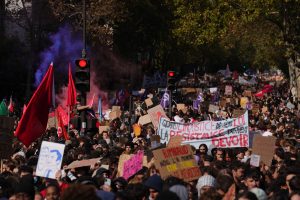
France is facing its largest student-led protest movement in decades, in which over 500 schools have been closed, with demonstrations beginning in late-September over insufficient school conditions, increasingly challenging the federal government. As of October 6, an estimated 71,500–266,000 protestors — including —14,500-56,000 in Paris — are protesting France’s lycées, or high schools, according to France’s Interior Ministry, while organizers estimate the number is closer to 450,000. Grievances include deteriorating building conditions, teacher shortages, overcrowded classrooms, insufficient resources, worsening testing scores, and demanding school schedules. A September 8 Organization for Economic Cooperation and Development (OECD) study found that in 2025, French students’ test scores in reading and mathematics prompted the largest drop in 10 years across OECD countries. Some are also challenging Parcoursup, the national university admissions platform, for transparency over the system’s placement algorithm, in which some claim the system is unfair and socially discriminatory.
The protesters, many of whom are students themselves, have blockaded schools, causing violent confrontation with police. The police have arrested thousands of people, and hundreds have been injured. One particular incident included a 15-year-old whose hand was blown off by a police stun grenade — a case that prompted the French government to pause police use of stun grenades. In another incident, a tear gas grenade shattered a 14-year-old’s jaw and many of his teeth. These events have created further aggravation towards the government, adding excessive force to a laundry list of grievances, especially due to the fact that many of the demonstrators are children.
The protests have drawn comparisons to the 1968 student demonstrations in France when demonstrations by university students evolved into a much broader social and economic crisis. In 1968, student unrest eventually converged with trade unions, producing strikes involving up to 10 million workers, effectively paralyzing much of the French economy. The protests caused then-President Charles De Gaulle to dissolve parliament, issue a state of emergency, and call for snap elections. While the level of protest has not reached that of 1968, the parallel is especially relevant given the fragility of the current federal government and the upcoming presidential elections scheduled to occur in April 2027.
Jean-Luc Mélenchon, leader of the far-left political party La France Insoumise (LFI) has strongly backed the students and criticized the government’s response to the demonstrations. However, Prime Minister Sébastien Lecornu has accused LFI of attempting to exploit the unrest for electoral purposes. Mélenchon has encouraged supporters to join the demonstrations, while simultaneously calling for nonviolence, and has continued to appear alongside demonstrators. While the protests themselves are not inherently a far-left movement, they have boosted Mélenchon’s popularity, especially amongst young French voters. According to a survey obtained by Le Monde, over 40 percent of voters aged 18-24 said they plan on voting for Mélenchon. While polls still indicate that far-right front-runner Marine Le Pen’s numbers are far ahead of Mélenchon, the youth vote could have a deciding factor whether Mélenchon would make it to the second round of the election in April 2027 to face off against Le Pen, ultimately deciding the next French president. Even in the face of an electoral loss for Mélenchon, his increased popularity and juxtaposition with far-right candidate Le Pen illuminates France’s widening political polarization.
The French government has responded to the protests with some temporary policy changes. On October 8, the French Education Ministry stated it would deploy an additional 3,000 substitute teachers to schools experiencing shortages of instructors. Education Minister Édouard Geffray conducted a meeting in Reims with schoolteachers that same day amidst continued demonstrations and stated that the government was actively implementing “an emergency plan” to address the national scarcity of schoolteachers, while the Prime Minister Lecornu signaled that the government would execute a “fully-funded” campaign that would be introduced by the end of October. However, it appears student organizations have rejected Lecornu’s initial promise as insufficient and continue to call for demonstrations.
However, the government’s limited fiscal room makes its response to the protests difficult. Lecornu’s minority government must navigate a fragmented parliament while attempting to pass the 2027 budget. The government faces pressure from its citizens and the wider Eurozone to reduce France’s deficit at a time when borrowing costs have risen sharply. Reuters reported that French bond yields have jumped 80 points since September, its highest level since July 2002. These circumstances will likely restrict the government’s ability to further increase government spending to respond to the protests, and it remains unclear whether the government’s promises will address the movement’s grievances. If demonstrations continue, particularly if they expand to include other sectors, they could further challenge the government’s ability to contain the unrest.
The protests, therefore, will likely only add more pressure on France’s political landscape surrounding the April 2027 election, which will take place without current French President Emmanuel Macron on the ballot. The protests have given some parties another issue through which to appeal to voters, but the underlying divisions extend to broader questions over public spending, social welfare, and the ability of the government to provide basic public services. The combination of growing public dissatisfaction and political fragmentation could make it more difficult for the next president to establish a stable governing coalition, particularly if the election again produces a divided parliament.
The post France’s Student Protests Test a Fragile Government appeared first on The Soufan Center.