

Neither U.S. nor Iranian leaders see a clear pathway for diplomacy to secure their core objectives, pushing both sides to posture and prepare for military escalation to levels not seen since the U.S.-Israeli campaign began. Tehran’s most pressing goal is to break what it acknowledges is a U.S. stranglehold on the Iranian economy, centered on a U.S. naval blockade of Iranian ports. On Saturday, the hardline Islamic Revolutionary Guard Corps (IRGC) Major General Mohsen Rezaei, head of Iran’s Supreme National Security Council, warned the country is currently experiencing one of its toughest periods since the 1979 Islamic revolution. Rezaei, who commanded the IRGC during the 1980-88 Iran-Iraq war and has recently threatened massive retaliation if the U.S. resumes combat operations, made the rare admission at a high-level government meeting about how to stabilize the economy. On Sunday, as supplies of Iranian oil afloat and still available for export were exhausted, Oil Minister Mohsen Paknejad stepped down due to “personal reasons,” according to Iranian state media. Beyond its immediate objectives, which appear intended in part to prevent another popular uprising, Tehran seeks to ensure that U.S. President Donald Trump and all future U.S. leaders will be deterred from attacking the Islamic Republic again.
The Trump team strives to restore the free and unfettered flow of commercial traffic through the Strait of Hormuz and obtain ironclad and verifiable Iranian commitments to abide by strict limits on its nuclear program activities. As his party faces an uphill battle in the key midterm elections on November 3 — the struggle in part a function of the economic consequences of the Iran war — Trump has sought to secure U.S. objectives with minimal risk to American lives. Since the beginning of the conflict, Trump has largely ruled out a U.S. ground offensive in Iran that would undoubtedly produce significant U.S. casualties, at several points telling journalists a ground operation is “not needed.” Instead, U.S. officials tasked the Navy with guiding and protecting oil and gas exports through the Strait. That mission is showing substantial success in moving shipments through the Gulf, and it has done so without requiring the large-scale use of deadly force against Iran.
The naval effort has enabled the flow of oil from the Gulf states and Iraq to reach nearly pre-war levels — while Iran’s oil exports remain blocked — but it has not yet altered Tehran’s negotiating positions. Frustrated that U.S. policy tools have not produced a war-ending accord at the bargaining table, Trump has stated openly that he is considering resuming major combat operations in Iran. Last week, he stated: “Now I have to make a decision: either Iran signs the deal, or it won’t exist any longer.” Senior U.S. officials met with Trump at the Camp David presidential retreat on Friday to discuss the war with Iran, as well as the escalating conflict between the Iran-backed Houthi (Ansarallah) movement’s militia and the Saudi-backed army of Yemen’s Presidential Leadership Council (PLC), which controls southern Yemen. Saudi leaders have asked Trump to conduct airstrikes against the Houthis, but he has thus far refused and is still leaning against doing so, although U.S. officials say he could change his mind. Those strikes would be intended not only to help defend Saudi Arabia but also to build leverage against Tehran by weakening the one remaining regional ally — the Houthis — still able to help Iran project power in the region.
As no clear pathway out of the stalemate with Iran is emerging, some close to senior U.S. policy circles assess that Trump is considering the use of ground forces in selected missions, such as the destruction or seizure of Iranian missile arsenals and nuclear installations. Yet the costs and risks of employing ground units, even in a limited capacity, are no less than they have been at any time during the war, and a ground operation remains far from Trump’s preferred option. It is also possible the U.S. might use ground forces not against Iran, but against the Houthis, should the PLC’s position become dire. Most experts assess that a Houthi seizure of the PLC’s capital in Aden and the rest of south Yemen would present a severe crisis for Saudi Arabia and U.S. interests, and it might trigger Trump to intervene.
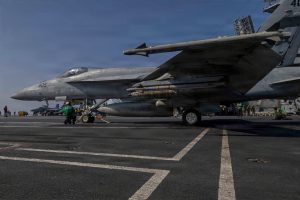
Reports indicate the U.S. is building up the forces needed to exercise any and all of the escalatory options under consideration. The USS Theodore Roosevelt carrier strike group is en route to the region to join two other carrier strike groups — the USS George H.W. Bush and the USS George Washington. Its arrival would bring U.S. naval strength to three carrier groups by the end of October, although some expect the overlap of the three groups to be brief. The Navy previously had three carrier strike groups in the Middle East in April, the first time since 2003, when the war against the regime of Iraq’s Saddam Hussein was launched. The Roosevelt is carrying more than 7,000 sailors and 2,000 Marines, the latter of which are aboard the USS Makin Island amphibious readiness group.
The assemblage of three carrier groups will raise the U.S. naval presence in the region to an unusually high level of more than 20,000 sailors and Marines afloat, along with hundreds of aircraft. These numbers would add to the nearly 40,000 U.S. military personnel still deployed to (damaged but still operating) bases in the Gulf states and other facilities in the region. The added amphibious readiness group includes a dozen F-35 stealth fighter jets, as well as infantry fighting vehicles, transport helicopters, armored personnel carriers, and amphibious vehicles. When combined with the USS Boxer amphibious readiness group already in the region, the force is capable of seizing a beachhead on the Iranian coast or specific military facilities inside Iran, should Trump decide to introduce ground forces.
Yet advisers caution Trump that Iran will implement its threats to preempt any U.S. escalation and would respond to a U.S. escalation with attacks likely to further roil global energy and financial markets. Iran and its allies, including the Houthis and Iran-aligned Shia militias in Iraq, will help Iran with missile and drone strikes on Arab Gulf state energy infrastructure. Over the past month, the Houthis have already been targeting Saudi refineries and its crucial East-West pipeline, as well as airports, as part of their battle against a Saudi blockade and Saudi-backed PLC forces. On Sunday, Iranian Foreign Minister Abbas Araghchi told a gathering of foreign ambassadors in Tehran: “If our enemies again choose the path of military confrontation, our response will be stronger than before, and we will defend ourselves with even more force … There is no military solution, nor any solution based on new sanctions … only negotiations based on justice and fairness” could end the conflict. On Tuesday, the IRGC stated through the state-backed news agency Fars that southern maritime transit routes through the Strait of Hormuz (protected by the U.S. Navy) will soon be “blocked” by the IRGC. Iran’s threats express its intent, but also serve as counter-messaging to Trump’s warnings, as both sides try to compel the other to meet their terms for a negotiated settlement.
U.S. officials take Iran’s threats seriously as a consequence of a change in Iran’s doctrine. After failing to deter U.S. and Israeli attacks in both 2025 and 2026, Iran has moved away from the strategic patience and military restraint that shaped much of its prewar approach, shifting toward a counter-escalation strategy that aims to transform the Middle East’s security and economic order in its favor. Reflecting its new approach, early last month, Iran’s Majles (parliament) Speaker and chief negotiator, Mohammad Bagher Ghalibaf, declared that “the era of ‘proportionate responses’ is over” and that any violation of Iran’s interests and security will receive a “faster, heavier, and more painful response.” Whereas there is no uncertainty about Iran’s new doctrine, the questions facing U.S. leaders include the extent of Iran’s remaining arsenal of missiles and drones to carry out the threats, and whether the U.S. stockpile of defensive munitions is large enough to limit the damage Iran seeks to cause.
The post U.S. and Iran Could Be Moving Toward Escalation appeared first on The Soufan Center.