

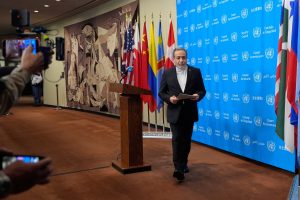
A week of high-level diplomacy on the sidelines of the UN General Assembly (UNGA), including the first U.S.-Iran meeting since June, failed to alter the strategic dynamics of the conflict. U.S. President Donald Trump rejected an Iranian proposal to fully open the Strait of Hormuz within seven days, contingent on the lifting of the U.S. naval blockade, unfreezing of Iranian assets, and other sanctions relief. The proposal was the subject of discussion in New York between Iranian Foreign Minister Abbas Araghchi and U.S. negotiators Steve Witkoff and Jared Kushner. Araghchi remained in the U.S. beyond the UNGA meetings, hoping for a formal U.S. counteroffer, but he departed on Tuesday, empty-handed. Yet U.S. and Iranian officials indicate that further talks will be held in the coming weeks in hopes of achieving a diplomatic solution or, at least, heading off a return to combat. Appearing on the NBC “Meet the Press” program on Sunday, Araghchi stated: “We are fully prepared for the time for the war to be resumed … even if it comes to a doomsday war,” while insisting that “[a]t the same time, we stand ready for diplomacy.”
Araghchi was in New York not only for possible talks with U.S. officials but also to help Iran’s head of government, President Masoud Pezeshkian, deliver a fiery speech before UNGA and meet with major U.S. media outlets. In his speech and interviews, Pezeshkian sought to amplify the domestic U.S. unpopularity of the conflict, painting Iran and its population as victims of unprovoked aggression. He and Araghchi expressed that deep-seated Iranian distrust of Trump and his team compelled the regime to insist that U.S. implementation of its concessions precede any agreed halt to Iran’s attacks on shipping through the Strait of Hormuz. The two senior leaders stressed that — in June 2025 and February 2026 — fruitful U.S.-Iran nuclear discussions were derailed by U.S. military assaults on Iran. Iranian officials also note that it was President Trump, during his first term, who terminated the 2015 multilateral Iran nuclear agreement, under which the International Atomic Energy Agency (IAEA) had judged that Tehran was complying.
Insulating themselves from hardline critics who argue Iran should not engage with the Trump team at all, Pezeshkian, Araghchi, and other government leaders argue that Iran has largely prevailed in the conflict and can bargain from a position of strength. Government leaders argue Iran can utilize its “escalation dominance” — the ability to act militarily with greater strategic effect than the U.S. — to achieve its core goals at the bargaining table. Iranian negotiators echo the threats issued by Islamic Revolutionary Guard Corps (IRGC) leadership that, should the U.S. refuse to lift the naval blockade of Iranian ports very soon, Iran will devastate the global economy and world energy markets with missile and drone attacks on shipping and on Arab Gulf state energy infrastructure. Regime leaders across the political spectrum argue Iranian strategy has depleted world oil reserves and U.S. munitions, increased U.S. interest rates and inflation expectations, and dampened the prospects for Trump’s Republican allies to prevail in the looming midterm elections. Tehran insists Washington must move first to accommodate Iran’s demands, and that unless Iran is able to use the Strait of Hormuz, it will not allow any country to use the waterway. On Wednesday, shipping observers reported the IRGC might have fired on three tankers trying to transit the Strait, an indication that Iran is willing and able to escalate.
The strategic logic of Iran’s threats is clear: its leaders seek to prevent Washington from entrenching the perception that the free flow of commerce through the Strait of Hormuz can be secured without an accommodation with Tehran. Implying that Iran will eventually defeat the U.S. blockade, Iranian state-linked media have in recent days claimed that U.S. warships pulled back earlier this month from their previous blockade positions. Previously located closer to the Iranian port of Chabahar at the entrance to the Gulf of Oman, the ships have now been moved farther into the central Arabian Sea to avoid Iranian missiles, Iranian media say. A published statement on Monday by Iran’s Supreme Leader Mojtaba Khamenei — who has still not appeared publicly since his March appointment, fueling doubts that he is alive — referred to a U.S. naval retreat. His message stated that U.S. forces are now refraining from advancing further “because of the painful blows they have suffered at the hands of the valiant fighters and the guardians of the Strait of Hormuz … Whenever they have taken that risk, they have brought harm upon themselves … And soon the Arabian Sea, too, will empty itself of them.”
Clouding the prospects for a diplomatic breakthrough, U.S. leaders convey the exact opposite impression, repeatedly asserting that it is the U.S., not Iran, that has gained the strategic upper hand. Trump, echoed by senior subordinates, asserts that the U.S. has “defeated” Iran, “controls” the Strait of Hormuz, and is positioned to dictate peace terms. The Trump team maintains the U.S. Navy’s escort and protection operations have largely succeeded in wresting control of the Strait of Hormuz from the IRGC. Trump officials cite U.S. military and other sources that assess that the flow of energy exports from the Persian Gulf has been restored to more than 80 percent of the pre-war level of 20 million barrels per day of crude oil, when including Saudi, Emirati, and other export routes that bypass the Strait. On Wednesday, JP Morgan and Goldman Sachs assessed that energy flows out of the region have now reached more than 95 percent of pre-war levels. Some shipping observation sources dispute those figures, assessing that mitigation percentages are far lower — closer to 50 percent. And many question how long the U.S. Navy can sustain its Strait-protection mission.
Citing other metrics, such as the collapse of Iran’s currency (hitting a new low this week at 2.5 million rials per dollar), U.S. Treasury Secretary Scott Bessent has claimed success for “Operation Economic Outcast,” the expanded U.S. sanctions campaign targeting all Iranian financial institutions and airlines. Bessent posted on X that his office had “dispatched [teams] across the globe to engage with countries and demand action against the Iranian regime … Türkiye and Oman announced the cessation of Mahan Air flights to their countries. The UAE has halted all flights by Iranian airlines, and top commercial banks in the UAE and Türkiye have stopped transacting with Iran.” Bessent and other top officials added that, in the past two months since the blockade was reimposed, Iran has only sold oil afloat outside the Gulf, and claims these volumes will run out by mid-October if the U.S. blockade continues.
As a sign of confidence — even if that confidence might be misplaced — Trump and his aides have begun to refocus their demands from opening of the Strait to extracting Iranian concessions on its nuclear program. Compelling Iran to accept strict limits on the program was the core U.S. justification for launching the war, but the issue faded to the background for several months as U.S. officials sought primarily to improve the flow of energy exports out of the Strait. The renewed focus on nuclear talks reflects a belief within the Trump team that the U.S. has largely broken Iran’s stranglehold on the Strait.
Yet there are few, if any, indications of Iran’s willingness to move toward nuclear talks before other outstanding questions are resolved. Some reports last week indicated that mediators, including Qatari and Pakistani officials, suggested that Tehran front-load nuclear-related concessions to gain Trump’s approval for an immediate end to the naval blockade and other sanctions relief. However, Iranian sources said that Iran is unwilling to offer any new nuclear concessions until its demands for an easing of the U.S. economic pressure are met and systematic, formal U.S.-Iran negotiations resume.
As the most vocal regime advocate for diplomacy and an end to the war, President Pezeshkian told U.S. media last week that Iran is willing to discuss limits on its nuclear program, but he argued Washington must first demonstrate that it is not seeking to overthrow his government. Both sides indicate a willingness to maintain dialogue and predict that additional talks will be convened. But with no additional U.S.-Iran meetings scheduled in New York, Araghchi left the U.S. on Tuesday and stopped over in Doha, Qatar, for additional discussions with the key mediator, Prime Minister Mohammed Abdulrahman Al Thani. He then reported to an Iranian cabinet meeting on Wednesday that the Trump team had formally responded to Iran’s seven-day proposal. But there are no indications that any breakthrough is imminent.
The post Dueling Perceptions Cloud Resolution of the U.S.-Iran Conflict appeared first on The Soufan Center.