

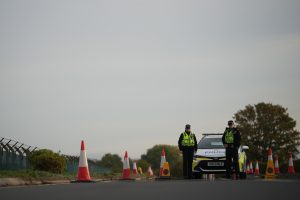
On Sunday, five British nationals from London were arrested for their involvement in an alleged plot against the Royal Air Force (RAF) Fairford Base located on the border between Gloucestershire and Wiltshire. The suspects were spotted in hoods and masks operating three white vans — at least one falsely branded with a British fuel company logo — toward the base. Several reports were made to authorities by local residents who reported the vehicles and unusual behavior. There have been competing allegations that the vans contained viable explosive devices; the suspects were initially arrested for violating the Explosives Act, though they were then released on bail. The arrests are being investigated as a terrorist incident and have raised major questions about potential geopolitical motives. Some sources have hinted at a potential Iran-backed plot to attack military personnel and assets used in the fight against Iran.
Back in March, the U.S. began using installations like the RAF Fairford Air Base for launching and landing long-range heavy B-1 and B-52 bomber missions carrying cruise missiles and other weapons deployed in its unfolding war against Iran. Initially, the UK government refused to allow British territory to be used for American military operations against Iran, with former Prime Minister Keir Starmer stating in early March that he did not believe the UK should be participating in “regime change from the skies.” However, under pressure from the Trump administration, Starmer’s government later approved the use of British installations for “defensive” purposes, allowing U.S. bombers to reduce flying hours to refuel at bases that have long runways and can support bombers with heavy payloads, like Fairford and Diego Garcia in the Indian Ocean.
Iran has denied its role in sponsoring the attack, with its embassy in London releasing a statement that called the “fabricated speculations” linking its government “unfounded and malicious speculation.” Though back in July, the Iranian Revolutionary Guard Corps (IRGC) explicitly named the Fairford Air Base when it threatened the UK for allowing American defensive assets to be used in the Iran war, warning: “any base used for aggression against Iranian territory constitutes a legitimate target for our forces.” The Fairford plot is not the first time that a British base was targeted amidst the U.S.-Iran war. In early March, the UK’s RAF Akrotiri base in Cyprus — housing American U-2 spy planes — was hit by what was believed to be an Iranian-manufactured Shahed drone, while Greek air defenses intercepted drones destined for Cyprus just days later, believed to be deployed by Iran-backed Hezbollah in nearby Lebanon. If Iran had truly sponsored the operation, it is a potential message for governments like the UK that have enabled U.S. military personnel and equipment — however limited in scope — to operate on their soil and indirectly support ongoing efforts to degrade the Iranian government, its forces, and its hold on the Strait of Hormuz.
Though, importantly, it is not yet clear that Iran is the responsible actor behind the potential plot. One source informed Reuters that law enforcement is investigating this case with multiple lines of inquiry. In addition to investigating the operation as an Iran-backed plot, sources have noted the possibility of the plot being connected to a Russian conspiracy to attack the base that supports American personnel and assets, as well as potentially an Islamist terrorist plot. There are also reports that the incident was not a terrorist plot in the first place, with the suspects released on bail days later, suggesting they did not pose a further threat, with unclear intent outside the RAF base. Adding to the confusion was a statement by U.S. President Donald Trump on Sunday, as reported by Reuters, in which he said that the suspects were looking to do “big damage.” The Independent reported that just a day prior to the arrests, villages near the base were told that some kind of attack was imminent. These data points further add to the confusion surrounding the alleged plot, arrests, and release of the suspects.
The unusual behavior at one of the UK’s most important airbases can spark many lines of inquiry, highlighting the tenuous nature of the UK’s security landscape under the weight of competing threats. The country has been the target of a string of plotted and executed assassination plots, acts of sabotage, terrorist attacks, intimidation, and other incidents by state actors, their proxies, and terrorist networks, revealing a diverse and unpredictable security climate without clear accountability. Whether the suspected plot was Iranian, Russian, or arranged by a non-state Salafist-Jihadist network, or a false-flag incident, the case reveals increasing vulnerabilities in the UK’s security landscape related to hybrid threats. Currently, the country’s MI5 intelligence agency has set the national threat level at the second-highest tier, “severe,” meaning a terrorist attack is “highly likely” based on available intelligence, terrorist capabilities, intentions, and timescale.
The post A Potential Terrorist Plot Against a British Airbase Shows the Continued Threat of Hybrid Warfare appeared first on The Soufan Center.