

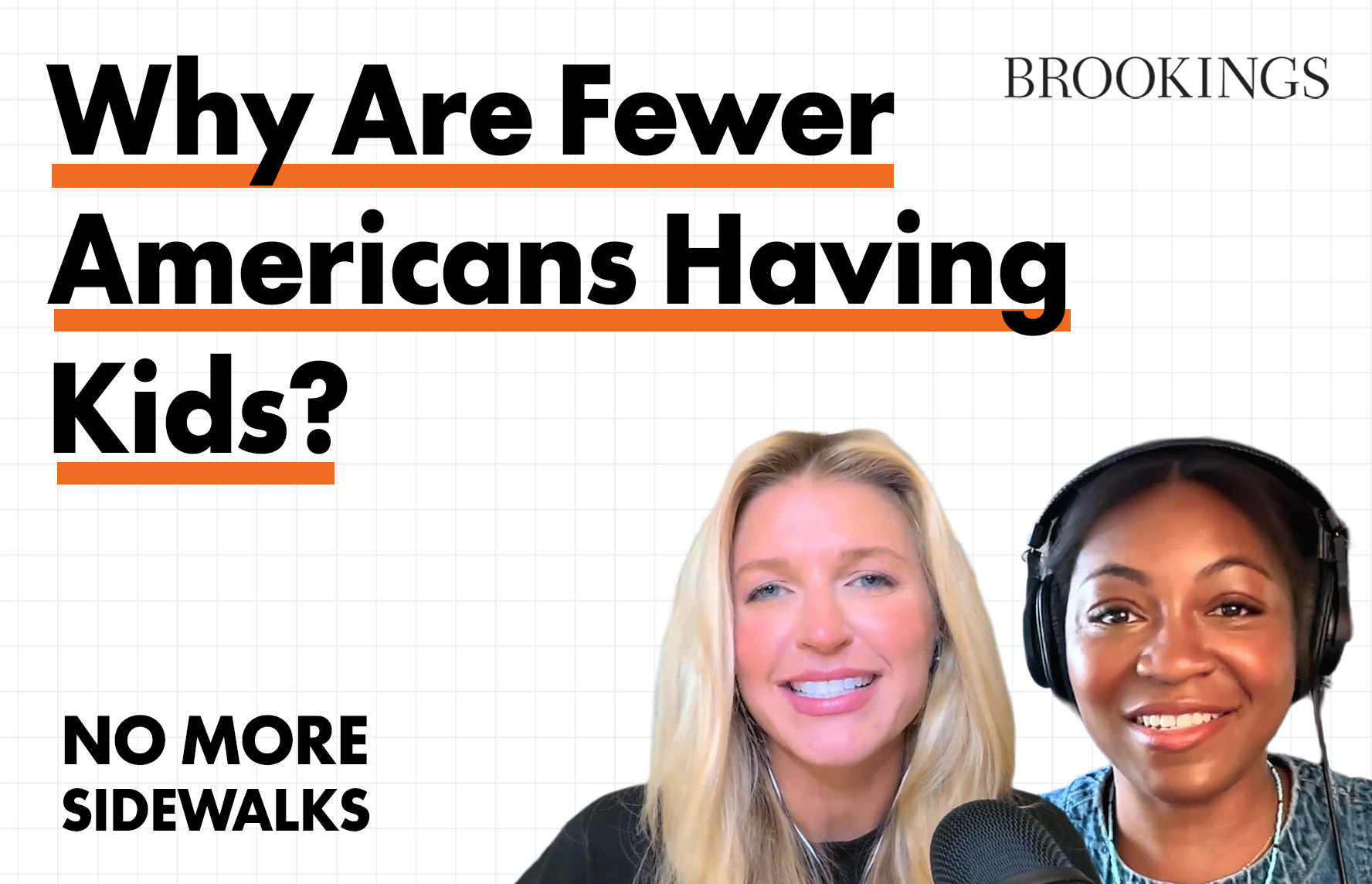
A growing number of American adults don’t expect to ever have children. What is driving this change? And what does it mean for society (and for those who are parenting) when there are fewer parents and children around? In this episode of No More Sidewalks, host Abby McCloskey speaks with Christine Emba, senior fellow at the American Enterprise Institute, about the massive shifts in sex and fertility over the last generation, plus cultural shifts, new fertility technologies, and what policymakers are promising—from cost-free birth to baby bonuses.
About the Host
Abby M. McCloskey is a columnist for Bloomberg Opinion and the Dallas Morning News. She is a nonresident fellow in Economic Studies at the Brookings Institution. She is founder and principal of McCloskey Policy LLC, a research and consulting firm serving business and political leaders across the country.
About the Guest
Christine Emba is a senior fellow at the American Enterprise Institute (AEI), where her work focuses on gender and sexuality, feminism, masculinity, youth culture, and social norms. She is concurrently a contributing writer at The New York Times and a senior fellow at the Georgetown University Initiative on Catholic Social Thought and Public Life. Ms. Emba is a contributing editor at Comment magazine, a board member at the American Institute for Boys and Men, and an editor-at-large at Wisdom of Crowds. She is the author of Rethinking Sex: A Provocation (2022).
- Listen to No More Sidewalks on Apple, Spotify, or wherever you like to get podcasts.
- Watch episodes on YouTube.
- Learn about other Brookings podcasts from the Brookings Podcast Network.
- Sign up for the podcasts newsletter for occasional updates on featured episodes and new shows.
- Send feedback email to [email protected].
Transcript
EMBA: People are worried both about whether they can have children, whether they can afford children, and whether the lives that said children might lead will actually be good.
[music]
MCCLOSKEY: Welcome to No More Sidewalks, where we talk about parenting today. I’m Abby McCloskey.
Making babies has never been more complicated or rare. The major fertility story is that fewer people are opting into having children at all. Never before has human civilization decided to shrink itself like this voluntarily. But what’s driving it? We know that fewer people are dating and having sex. Marriage rates, which are highly correlated to child-rearing, are down, and there are seemingly new challenges to fertility with sperm counts dropping and older parents and rising miscarriage rates. And then there’s the ability to de-link sex from procreation with increasingly widespread use of IVF, continued high rates of abortion, and pornography on demand. Those who do decide to go on and have children may increasingly be designing them with embryos tested and perfected.
So what does all this mean for society, and what does it mean for those of us parenting in the middle of a fertility crisis? Christine Emba is a senior fellow at the American Enterprise Institute. She’s a writer at The New York Times and a senior fellow at the Georgetown University Initiative of Catholic Social Thought and Public Life. She’s also the author of a great book called Rethinking Sex.
Christine, welcome to the show.
EMBA: Thanks for having me, Abby.
[1:27]
MCCLOSKEY: If you were going to summarize what’s going on in our fertility culture in America in a few sentences, what would you say?
[1:35]
EMBA: A few sentences probably doesn’t do it justice, but in a word, I would say it’s concerning. As you pointed out, fertility rates are down. This is downstream of marriage and coupling rates being down. But also, I think the mood around fertility is dampened. People are worried both about whether they can have children, whether they can afford children, and whether the lives that said children might lead will actually be good. So it’s both psychological and material. There are a lot of new things holding potential parents back.
[2:13]
MCCLOSKEY: And yeah, this feels like a big step change, at least to me now as an adult and a parent, from what the fertility culture would’ve been like even 10 years ago, let alone like in the ‘90s and ‘80s in America. Have you seen a big change?
[2:30]
EMBA: Yeah. No, I think that’s definitely the case. One of the main things about how our sexual culture, our marriage culture, and of course our fertility culture has changed in this moment is that it is optional. You know, even 10 to 20 years ago, it was kind of expected that the next phase of life, adulthood, looked like finding a partner, getting married, and starting a family.
Having a family used to be the norm, what was expected of you as an adult. And now, frankly, there are a lot of options. And in some ways, you know, some reasons for this are actually good ones. Women have fully entered the workforce. They feel freedom to make decisions about their own lives. They feel economically strong in and of themselves, such that they don’t necessarily feel like they need to depend on a partner or have a family unit to stay solvent. And I think that that is a good for women.
However, there are also these pressures pushing in on the other side. You know, the flip side of this sort of newfound freedom is this idea, a new understanding, I think, that children might be a threat to that in some way. Instead of assuming childbirth as a norm, people are weighing having children against the opportunity costs of what they imagine their sort of free and economically strong life might look like.
And then I think there are the circumstantial issues around childbirth that as we have shared more information, and frankly more complaints about family life online and in media, younger people feel more scared, I think, than they used to.
[4:16]
MCCLOSKEY: Well, and I want to talk about all of those fertility concerns. But your book, Rethinking Sex, when it came out a couple years ago and I was listening to the book talk, I thought about how many of the conversations about the birth rate and fertility rate almost start too late in the conversation, and there’s something to be said about going back to what sex and relationships and marriage look like in American life right now.
And so I was wondering for those in our audience who haven’t read your amazing book and who should, your main points of it and and why it’s kind of the gateway into this broader fertility discussion.
[4:54]
EMBA: Yeah, thank you for bringing that up. And yes, listeners, you should buy Rethinking Sex: A Provocation. So I wrote Rethinking Sex coming out of reporting on the Me Too movement, and the Me Too moment. And I found myself, you know, compelled by the big, scary cases, the Harvey Weinsteins, et cetera. But more interested in the Me Toos that were coming from just young women, and their Me Toos were more in the vein of, “Uh, I had sex that I didn’t really want to, but I guess I thought I should. And, you know, I guess that’s normal. Me too. Isn’t that normal for all of us?”
And my question was, is it normal for all of us? If it is, that seems pretty bad actually. We need to maybe revisit what our sexual landscape looks like such that this has become, you know, the average thing.
So Rethinking Sex was, you know, an exploration of sexual culture at the time, how we’d gotten to this place where so many women said, “Me too” to these, like, bad negative experiences of sex that they didn’t want. I made kind of two main arguments in the piece. One that we had started talking about consent as though it was an ethic, as though any sex that you consented to was okay by virtue of having said “yes.”
And I said that actually consent is not an ethic. You know, it’s it’s the floor. It’s a legal argument, but it does not actually make sex moral or good. And so we need to actually think about what a real ethic for good sex and good relationships would look like.
And then also that we needed to think about and address some of the things that had changed about our sexual landscape, especially for women, that might not have been as ideal or as perfect as we thought they would be.
So for instance, the idea that having a totally private and online sex life and dating life was a good thing. I argued that actually having some community involvement, you know, might’ve, might’ve been good, in fact. The idea that men and women, you know, approach sex in the same ways and should be equally casual about it. I argued that actually, you know, maybe maybe there’s some differences there that we need to pay attention to.
[7:18]
MCCLOSKEY: Well, it was interesting to me about your book, just seeing how fast things are changing because, you know, I’m a millennial. I think a lot of what I read of the spirit of your book was kind of encouraging women to say to be a free, fully developed member of society doesn’t mean you have to go out and have sex like a man. Almost encouraging a bit of a thoughtfulness and connection and return of intimacy and and all these things.
But now it, it actually seems like there’s just been a pullback altogether from sex. It’s it’s called a sex recession. A quarter of young people aren’t having sex at all. And this, of course, is at one of the foundational pieces that then we get into a broader discussion about birth rates and fertility and relationships.
But when you look at the general pullback from sex, why do you think that that’s happening now? Like, in some ways, maybe people listen to you and they’re like, “We’re not going to do all the casual sex stuff anymore. We’re just going to stop, and maybe that’s a good thing.”
[8:22]
EMBA: Yeah. No, that’s a great question. So in Rethinking Sex, actually one of the big themes running through the book is just an understanding, not even a new understanding, but actually returning to sort of the the basic understandings of feminism that came about in the second wave.
You know, in the ‘90s, 2000s, ‘10s, feminism became linked to this idea of sex positivity writ large. The idea that to be a good feminist, to be a good modern person, you had to be out there having sex with strangers, collecting all of these experiences, good or not. That, you know, to be like a real adult, you should be having casual sex even if it didn’t actually feel that great to you.
And I pointed out that, you know, the original second wave feminists described sex positivity not as, you know, having sex with strangers, but exactly as you said, Abby, just women being able to be fully human in the world, including, you know, being allowed to understand their own sexual desires and needs. But that didn’t necessarily mean treating it casually. And so I argue for that older understanding of the feminist moment and sex positivity that hasn’t kind of been taken over by media and other forces.
And I think that that did resonate with readers, that, you know, sex positivity, meaning that you had to force yourself to do things that you didn’t want to do, was not actually freeing.
[9:58] And there were enough examples, I think, in the book of people, of women and men, frankly, who had adopted various practices because they almost felt like they should. And, in hindsight, didn’t really enjoy what they were doing. That resonated with a lot of readers.
I think that maps onto kind of a broader, a broader description of our sexual landscape today. I think Gen Z especially, but also millennials who are getting older, are sort of rethinking, as it were, the ideas of sex and relationships that they’d been given, and finding some of them kind of distasteful. I think especially in the current moment, there’s been a broader realization of the role that pornography has played in sort of the formation of how people are having sex. And for women, it’s not attractive. They don’t necessarily want to go into an encounter and be surprise choked or be treated as a situationship.
For men, I think, there is both a kind of fear of approach sometimes in a post-Me Too environment, and understanding that I don’t think is totally correct, that women don’t want to be bothered by you, so don’t even bother trying. Or as a pushback from I guess a backlash to the Me Too moment, a rise in kind of manosphere discussion of sex and women that really treats women as objects who are either to be treated poorly or seen as unapproachable and unavailable to normal men. And so men have kind of backed into their own corner too.
And so the genders are sort of separating. They’re both, I think, more scared of each other than they used to be, and more living in their own separate spaces. Which then, of course, means that they’re not living with each other, not forming relationships, and that leads to lower fertility.
[12:07]
MCCLOSKEY: Right. And then goes into, of course, marriage rates, which I think it’s something like less than half of American households are now led by a married couple, and this is the strongest predictor of any of going on to have kids.
And so when you look at that drop in marriage, how much of that to you is this broader, the culture of kind of almost like a frozen out sexuality, kind of not super in as many human relationships as we are with kind of the AI chatbots or OnlyFans or kind of doing that stuff online as opposed to in a committed relationship with somebody else. Like, how much of that do you think is contributing then to this kind of next point on the spectrum towards having kids, which is marriage rates?
[12:53]
EMBA: You’re exactly right to point that out. I mean, people talk about fertility, but fertility is downstream of all these other things. Right? Having a baby, like, generally first you, you know, have to have friends such that you find someone to date. Then if you date, you form a couple and presumably get married. And only then are you likely to have children. And at the very beginning of the funnel, even just the sort of having friends, dating people, that group has become a lot smaller and less likely.
I think that some of it is due to sort of cultural shifts. But I think there are just a number of factors interplaying. There’s, you know, the social angle, kind of what we were talking about, men and women, you know, the genders increasingly diverging and becoming less trusting of each other.
But there’s also, I think a real material shift. Again, like, when we think about Millennials and even Gen Z. Millennials, you know, came up having seen the 2008 recession. Gen Z had many of their formative years during the COVID pandemic. There’s a real sense of uncertainty in both generations and insecurity about their financial standing, whether they’ll be able to have the life that they thought they would have. Sort of this question about the American dream, like, “Will I have a better life financially or otherwise than my parents?”
And I think this level of insecurity has caused people to push back a lot of life moments. People are marrying at older and older ages. Often when you talk to young people today, they talk about like, “Well, I have to, I have to make enough money. I have to be able to afford a house. I have to do X, Y, and Z before I can even, you know, become stable on my own, before I can even think of getting married.” So that, yeah, that of course pushes children back.
And that even, I think the political and, honestly, the political climate and many young people cite the climate climate as a sort of, “I don’t really know where this world is going. AI has now become a factor. I’m not sure if I want to bring children into it.” So they wait.
[15:10]
MCCLOSKEY: Yeah. And I think that that can be really easily dismissed by people who say, “Look, the world’s always been unstable.” Like, can you, you know, Stone Age, like that seems really unstable and you’re bringing kids into it, so kind of everyone’s gotten too soft and just kind of just keep going on.
But I think, and I would bring it back even before the financial crisis to 9/11, there has been a tremendous season of instability and anxiety, and I think to dismiss it is to dismiss a a core part of what’s happening in our culture with relationships.
[15:42]
EMBA: No, I think that’s a really key observation. I think sometimes pundits and perhaps even frustrated potential grandparents think that it’s, you know, it’s selfishness or something. Their kids just won’t get it together.
But I, I actually think you’re hitting on something really true. I think people do modify their expectations for themselves or try to tamp down desires if they don’t think that they’ll be able to fulfill them.
Obviously this is, you know, my surmising, but I think that for many young people, it’s not that they are anti-child or, you know, don’t like the idea of a family, but exactly as you describe, it feels so impossible on different levels, whether it’s the financial level, whether it’s, you know, I’d love to have children, but I just don’t see myself finding someone who I can marry in time.
That, you know, they sort of state like, “Well, I don’t see it happening for me.” Not necessarily as an expression of triumph, but just as a sort of this is what it looks like. I’m not going to get my hopes up.”
Often if you ask young people, you know, “What would it take for you to have kids?” They actually can tell you, “Well, like, if I could feel certain that I could pay for healthcare, if I could feel certain that I could pay for housing and have enough space to have a family, if I had a good partner to have a family with, then I would have kids.” And they’re excited about it, but they don’t see those things in place.
Actually, one of the more interesting data points that I’ve seen recently, Alexandria Ocasio-Cortez, the representative, has been really public about her egg freezing journey, at 36. And there’s been a lot of criticism of her as sort of being a a girl boss or putting off a family because of her career.
But the researcher Marcia Inhorn interviewed hundreds of women who have frozen their eggs about why they did so, and basically none of them say, “Oh, I just really wanted to work longer,” you know, “I’m putting off a family because of my career.” Almost all of them say that they haven’t yet been able to find a partner with whom to have kids with.
And if they had a partner, they would do it. And in some sense, like, that’s why they’re freezing their eggs, because they still hope to have a family, but it just doesn’t seem possible in the moment. And I think that’s reflective of a broader mood.
[18:17]
MCCLOSKEY: What’s interesting to me too is that these surveys, and I’ve seen them too— New York Times has a a great one that talks about the cost of living and, like you said, healthcare, and actually, like, a time shortage and financial shortage, and if these things were fixed, you know, we would be more likely to have kids, the folks surveyed say.
But then when you look across the developed world, this is happening everywhere, in countries that have really generous social safety nets and healthcare and paid leave and, much lower levels of single-parent-led households. Like, the dynamics can be really different across countries, and yet this broader decline, I think we’re seeing it, it’s basically everywhere other than a couple places in Africa.
And so this is why you have folks like Elon Musk, among many others, who are saying we’re in the middle of a demographic collapse and whether it’s people looking at their option set and saying, “We don’t wanna have kids,” or I, I think there probably is still a part of it that might be just… you, you bring it up in Rethinking Sex, where I think there might be a part of it that’s still selfish. Like, there there actually is a part that seems like to be free is to be unattached, to be unconnected.
You know, when I think of some of the influencers I see who don’t have kids or spouses, it, it feels very indulgent in some ways. So I think both of those strands are there.
But regardless of which one is more significant, the result is we’re at a level in the U.S. and pretty much everywhere around the world where we’re having less kids than we need to kind of keep our species alive. So when people say it’s demographic collapse and, you know, kind of this whole human experiment is on the brink, is that an overreaction to you? Is that, is that a prescient view of where we’re going?
Kind of how do you think about that, of going through these very individual decisions and should I date, should I marry, should I have kids, to, you know, as a, as a human population, we’re starting to flirt with extinction?
[20:13]
EMBA: Yeah. You know, when you phrase it like that, are we moving towards extinction? I tend to, you know, want to say, “Okay, you know, it’s, it’s not that bad yet.”
MCCLOSKEY: Slow down.
EMBA: But there is, I mean, a a big demographic slowdown, you’re right, across the sort of wealthy world especially. But even in less wealthy countries, once they gain more wealth, people start having fewer children.
I think there are a couple of different threads in that question that are kind of interesting to pull on. So one, you note that even in countries, you know, in Scandinavia, in France, like in Korea, countries that have better and more supportive policies for families, you’re still seeing people having fewer children. And that kind of ties back to what, you know, you were saying about people saying, “Well, you know, we used to have kids during plagues and famines, et cetera. Like, why can’t we do it now, even if things are scary?”
I think one of the things that we tend to, I guess, not underestimate is the word, but not think about enough, is how pervasive our anxieties have become in some ways. Like, yes, there used to be crises in the past, but you didn’t know about all of them. You know, even in a country like Denmark, where sure, there’s better maternity leave, better daycare, et cetera, you’re still constantly getting the online feed of there’s a war here, the climate’s dying there, politics are bad across the world.
So you’re still making decisions in this broader cloud of, you know, felt anxiety and uncertainty, even if it isn’t reflected in your country’s policies yet. We’re so much more connected and so much more aware of potential bad things, I think, that it weighs on people in a different way.
You know, I, I can imagine the influencers that you’re talking about. Right? The sort of like DINK, dual income, no kids, “I’m going on vacation. Yeah, it’s so great to not have to wake up early and, like, change a diaper. I can be drinking mimosas at brunch,” or whatever. I think some of that may go back to what we were talking about previously, about the sort of, you know, doth protest too much question, where you don’t feel like it’s possible for you, so maybe you’re kind of making the best of it with what you have. But also, yes, this idea that there are many more options and other things that you could do.
I think because demographic slowdown has been happening over time, and especially in larger urban centers, one of the things I’ve noticed is that there are many more young people who don’t have any experience with kids or babies. They didn’t grow up with a lot of siblings. They spent their childhood with their parents pushing them, you know, into travel soccer and to, like, study, to excel. They weren’t babysitting or, like, hanging out. And so kids seem really foreign. Like, the idea of having kids, it’s like, “What? I don’t, I don’t even understand how this works. It seems like a lot of work. It’s very overwhelming and frightening.”
[23:30] And then often a lot of parenting content, especially in the sort of, like, gentle parenting vein, seems to be of parents who are just like constantly monitoring their children and/or being trampled by their children’s whims. It’s like to be a parent is almost depicted as sort of, yeah, be a sad servant of a little tyrant who takes over your life and who you have to cater to all day long, and, like, speak to in soft tones and do everything for for 18 years. That’s not that attractive.
And again, if you’re unfamiliar with or don’t have as much family experience yourself, the upside is kind of unclear. And I think that has actually been more of a turnoff than we register for people thinking about having kids.
[24:27]
MCCLOSKEY: Yeah. And I’m really intrigued by, you know, I’m always intrigued by the future. Who’s not? But the slowdown has been happening for for some time, as you brought up, and yet we’ve never been kind of at the level we are now. And I’m really kind of intrigued, you know, the extinction, demographic collapse aside, like what it actually feels like 10 years from now, 20 years from now here in America where people have less families, smaller families.
[24:56]
EMBA: Yeah. You know, one of the sort of fascinating examples of this that I’ve actually seen play out over and over again and have, like, talked to friends and peers about is the continuing argument about crying babies on airplanes. Are you … Have you come across any of these?
MCCLOSKEY: Argument or, like, you don’t really love to have a crying baby on an airplane, and thus babies shouldn’t be on an airplane? Is that what you’re getting to?
EMBA: Yeah. Well, that’s the argument, right? There are people who are like, “Well, you know, you bring your baby on a plane and, like, it’s crying and you should control your child.” ” Why is this baby in my space?” Or like, kids in restaurants, like, “Why are they even there?”
And I mean, to me personally, I’m, like, Well, also children need to go places. Like, you were a baby too, and presumably cried. Like, we can, we can make space for babies. They’re the next generation.
[25:48]
But I think that is sort of a hint at what a a less demographically solid culture looks like in a sort of felt sense. As people become less used to children and see them as much more of an option. And this is actually something the Georgetown legal scholar Robin West has described in her work. Having made children an option through the availability of birth control, abortion, et cetera, et cetera, we have developed a sort of social sense that, “Well, you made the choice to have a kid. It’s your responsibility. I don’t want to be bothered by it. I don’t have to help you with it.”
And I think that becomes more of a norm instead of like, “Oh, children are people too. They’re part of the fabric of society.” It’s like, “Why are there children in this space? It’s for adults. What is your baby doing bothering me here?”
It becomes more hostile to families in ways both interpersonal like that, but also structurally in that instead of building playgrounds or parks, we use that space for other things. Instead of spending a lot of time thinking about how we fund education in schools, we are diverting that to other causes.
I mean, just thinking about the effect of having fewer children and a smaller next generation policy-wise, you know, we are going to have more old people than young people working. And so what does that mean for healthcare costs and the people who take care of them?
I think that’s what a lot of policymakers actually fear when they talk about demographic collapse, this sort of upside down pyramid where there are fewer young people supporting a lot of older people and economic shrinkage. And those are, you know, real, but telling people to have kids to juice the economy is is not really a selling point.
[27:50]
MCCLOSKEY: Everyone’s trying to figure out how to turn this around, but there’s a particularly, like, energized contingent, it feels like, within America’s Republican Party.
And so I want to talk about kind of, we’ve talked about fertility as the, in some ways, the end of this long spectrum before it about our culture around sex and relationships and dating and marriage, and now you’re talking about having babies, and most of the kind of toggles we think about in public policy in Washington around fertility are about that very end point, because how do you impact everything leading up to that it’s not exactly quite clear.
And then there’s questions if we should even be toggling with the fertility level at all, because is that government’s role? But suffice it to say, there’s a lot of ideas for how to do it, and so I just kinda want to go through a rapid fire round for you, given the conversations you’ve had, the reporting you’ve done, of what would actually be helpful.
So arguably the biggest one, and this is a bipartisan one, this is not just a a MAGA one, is increasing the size of a child tax credit, which is basically to say if you have a baby, when you file taxes, until that child ideally is 17, leaves the home, you’re going to get an annual check for a thousand bucks, two thousand bucks. What if it was $5,000? What if it was $6,000? Do you think that would help the fertility crisis?
[29:07]
EMBA: That option always kind of makes me laugh a little bit. It has been tried. South Korea, um, which is experiencing one of the biggest demographic dives has has tried this. It was tried in Hungary, and elsewhere, and it doesn’t really seem to have an effect.
Honestly, if you think about it just for, like, a few moments, that makes sense. Having children is a sort of all-consuming and life-changing choice for the next 18 years. Even conservative estimates from think tanks tend to say that, you know, one child will probably cost, you know, $200,000 to $300,000 over a a lifetime. Giving somebody $1,000 to have a kid is not going to cover that. That is not going to change someone’s mind. Nobody is like, “Ah, well, I was thinking about having a child or not having a child, but this person’s offered me $5,000, so I guess I’ll, I’ll change my life.” That’s not how people think.
I mean, I think that there should be better child credits, and far more direct support for parents, but I don’t think that that will change people’s minds unless the number is actually huge. I think it might help people who are perhaps on the bubble, but it will probably just go to people who are going to have kids anyway.
[30:27]
MCCLOSKEY: But providing maybe relief for those folks, even though it’s not changing decisions. What about more structural things like, you know, something I’ve written a lot about is paid parental leave, like you have time protected away from work. This is kind of a societal statement that this is special, sacred time that’s worth setting apart, or different childcare options, which tends to top lists of what people can’t afford when they think about having kids that make them worried.
Or I don’t know, honestly, to some extent maybe finally fixing public schools in K through 12, which makes people think, I don’t know, you know, then do you have to start saving for private school too, in addition to college, in addition to childcare, and all of a sudden this is becoming a bit much. Kind of what about some of those structural changes?
[31:10]
EMBA: So I do think that structural changes around paid parental leave, better childcare or even subsidies for childcare if people don’t want to put their kids in, I don’t know, a state-run daycare or something, that is something that I I think might move the needle.
I’m not sure how far. But yes, exactly as you were saying, when people talk about, you know, their fears around having children, one major one is losing their job, or falling back in their job such that they are not able to support their families in the future. And yes, our our lack of paid parental leave is a signal that, you know, we don’t really care about this aspect of people’s lives, and we’re not making room for it. So I think that would actually, you know, make a difference in people’s comfort in stepping away to to do this family thing.
I think daycare costs and childcare costs are huge. Just reading different family estimates, people spend often what would be, like, a month’s rent or mortgage payment every month on daycare. And I think knowing that they wouldn’t necessarily have to do that might make the idea of having a child less daunting, assuming that, you know, the subsidies offered, the facilities in place were actually up to standard and high quality. Yeah, I think those structural fears could be alleviated somewhat.
[32:38]
MCCLOSKEY: Okay. Three more with kind of thumbs up, thumbs down, or kind of a in between thumb thing. Free birth, but which, but not freedom like you can birth any way you want, but the … you know, giving—
EMBA: Birthing tubs for all.
MCCLOSKEY: Very fun. No cost births, like, you don’t have a payment when you go to the hospital or at home, whatever, after giving birth. Is that a thumbs up, thumbs down, thumbs … ?
EMBA: Thumbs up. I’m not sure that everybody knows how much birth costs actually, so it may not be top of mind, but I’m sure it would help.
[33:07]
MCCLOSKEY: What about a bonus if you get married? You get a larger tax credit, you get a actual, like, check for getting married, you get your wedding costs covered with that kind of stuff. What about that?
EMBA: I’m gonna thumbs down that, because I honestly think it would weird people out. And it seems like it could be manipulated in a lot of different directions. I don’t think people would find it attractive.
[33:31]
MCCLOSKEY: And last but not least, subsidies for IVF.
EMBA: I do think that that would help. I think that people are having children later in part because of cost, and the felt need to save up, et cetera, et cetera. And when you start having children later, you have fewer kids, unless you are able to afford fertility help often because fertility declines. So that might help people to have more kids later on.
[34:03]
MCCLOSKEY: So to close, I have two questions. One is kind of the the personal level and all the conversations you’ve had, many of the stories that are in your book about, you know, what advice would you give, and you can choose which person you you want to speak to here, to either someone who doesn’t plan to become a parent and kind of doesn’t see the value in any of this stuff and kind of feels like maybe it’s not even an option anyway, and is that even a path worth persisting or, or what have you.
And the other is to someone who actually is a parent in the middle of this fertility crisis and feels like very alone. And how would you speak to, I don’t know, the the narratives they tell themselves or the advice that you would give them? And then I want to end with a more macro question. But what would you say to just an individual person in the middle of this fertility swirl?
[35:01]
EMBA: So I think to the person who doesn’t have kids and is not sure if they want them in the midst of insecurity, et cetera, first I would point out that our media and our visible consumption makes having kids seem very hard and expensive, and you actually don’t have to have a perfect life to have kids. Like, it’s okay to share a bedroom. I did. Like, you don’t have to be the gentle parenting queen. Kids don’t have to cost, you know, twenties of thousands of dollars every year for toys and accessories and the newest stroller.
I think you need to be a good enough parent, but that can look like a lot of different things, and can bring a lot of love into your life, and expand your life in ways that you might not have expected and cannot even imagine in this moment.
[35:59]
MCCLOSKEY: And societally, we’ve talked about this as a whole kind of journey, our sex culture, relationship culture, marriage, fertility culture. If you could kind of lay a piece of, we call it sidewalk on this podcast, but basically a structural support of some sort, for those who decide to go on to become parents, what would it be?
[36:24]
EMBA: Yeah. I mean, thinking of structural changes actually at the very beginning of the funnel, I would get rid of dating apps, frankly, because I think that they’ve made relationship formation just worse and harder and less likely, and without those, you’re not going to get to babies.
For people who are already sort of in couples and want to have children, I think the track I would lay is, yeah, some of the structural change you were talking about. Off the top of my head, I would say better maternal and paternal leave, that is longer and paid so that families feel like they will have time to bond with their children, but also not feel like they’re falling behind in the world for having a family.
MCCLOSKEY: Yeah. Well, Christine, you are a fount of knowledge and wisdom, and thank you so much for having this conversation with me.
EMBA: Of course. Thank you for having me.
[music]
MCCLOSKEY: I’m Abby McCloskey from the Brookings Institution, and this is No More Sidewalks: Parenting Today. This podcast is produced by the Brookings Podcast Network and the Center for Economic Security and Opportunity at Brookings.
Thanks to the production team, including Ike Blake, supervising producer, Fred Dews, producer, and Daniel Morales and Teddy Wansink, video editors, and Chris Chang, audio editor.
Plus, thanks to Tara Watson, director of the Center for Economic Security and Opportunity, Stephanie Holzbauer and Tyler Hernandez for their support. Daniel Morales also designed the show artwork. You can find all episodes of No More Sidewalks wherever you get your podcasts and on the Brookings website.
And finally, find research on family policy and economic security at Brookings dot edu slash CESO.
Thanks for listening.
The Brookings Institution is committed to quality, independence, and impact.
We are supported by a diverse array of funders. In line with our values and policies, each Brookings publication represents the sole views of its author(s).